Cold Email A/B Testing in 2026: How to Run Tests That Actually Lift Reply Rates
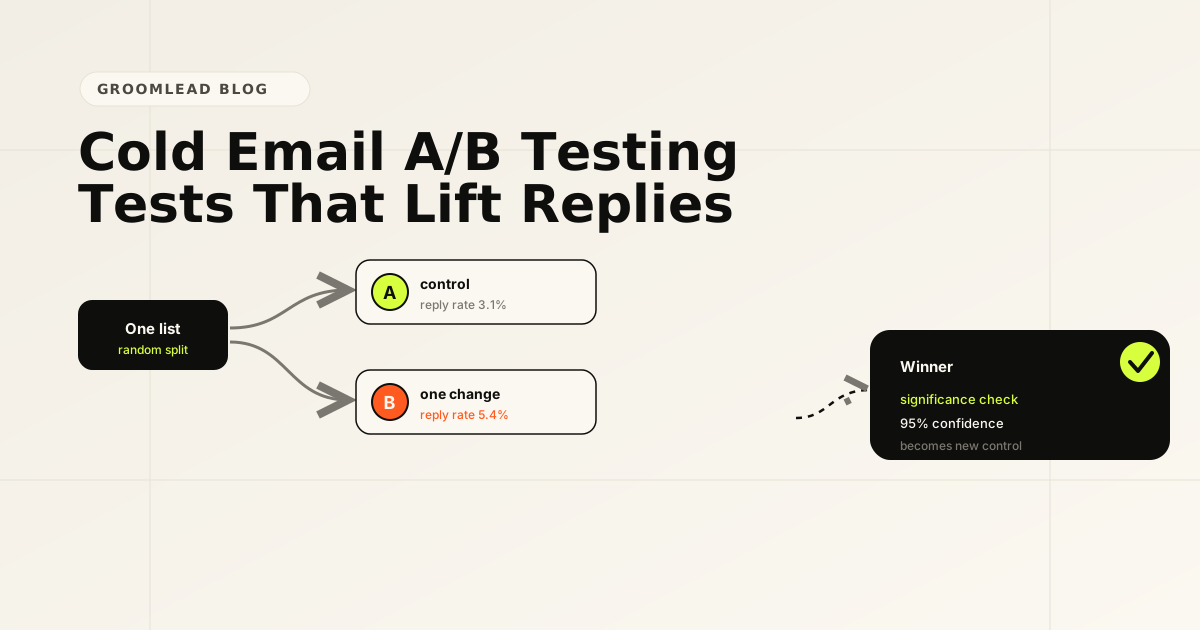
Short answer: A cold email A/B test is a controlled comparison where you split one audience into two groups, send each a version that differs by exactly one element, and keep the version that produces more of the outcome you care about. It only works if three things are true: you change one variable at a time, you send enough volume per variant to trust the result, and you measure the right metric for the element you changed. Break any of those and you are not testing, you are guessing with extra steps. This post covers how to set up a test that holds, what to test first, how much volume you actually need, and how to roll a winner into your live sequence without fooling yourself.
Most outbound teams say they A/B test. Very few run tests that would survive a second look. The usual pattern is to write two emails that differ in five ways, send 40 of each, declare a winner because one got three replies and the other got one, and move on. That result is noise. The rest of this post is about replacing that ritual with tests you can actually act on.
What a cold email A/B test really is
An A/B test splits a single, comparable audience into two random halves. Group A gets the control, group B gets one deliberately changed element, and everything else stays identical: same send window, same sender, same list quality, same follow-up. At the end you compare one metric and keep the better version. The discipline is in the word one. If the subject line, the opener, and the call to action all differ between A and B, a win tells you nothing about which change caused it.
The reason this matters more in cold outbound than in most marketing is that your inputs are noisy. Deliverability, list freshness, and timing all move reply rates around on their own. If you do not isolate the variable and control the rest, those background swings drown out whatever you were trying to learn. Teams that work with GroomLead treat testing as part of the GTM system, not a one-off experiment, which is the only way the signal survives the noise.
The one-variable rule
Pick a single element, change only that, and hold everything else constant. The elements worth isolating, roughly in order of impact:
- Subject line. The biggest lever on open rate, and the cheapest thing to test because you can change it without touching the body.
- First line or opener. The opener decides whether a prospect keeps reading after the subject earns the open. Personalized versus generic is the classic test here.
- Call to action. A soft ask like “worth a quick look?” versus a specific ask like “open to 15 minutes Thursday?” often moves reply rate more than any other body change.
- Length. Three sentences versus eight. Shorter usually wins in cold, but it is worth confirming on your own audience.
- Offer framing. Leading with the problem you solve versus leading with a proof point or a peer reference.
Test these one at a time, in that order, because a subject-line change you make before you have a working body just muddies both results. Lock the winner of each test before you start the next.
Measure the metric that matches the element
A subject-line test is an open-rate test. A body or CTA test is a reply-rate test. Mixing these up is the quietest way to draw a wrong conclusion: if you change the subject line and then judge it by replies, you are measuring the body’s performance through a different front door, and the numbers will wobble for reasons that have nothing to do with your change.
Map each element to the metric it actually controls:
- Subject line and preview text -> open rate (or, where you cannot track opens cleanly, treat the subject as an input to reply rate and keep the body fixed).
- Opener, body, length, offer, CTA -> reply rate, and specifically positive reply rate, because a version that triggers more “please remove me” replies is not winning.
- Send time and day -> reply rate again, but run these as their own tests rather than bundling them with copy changes.
Reply rate is the metric that ties to pipeline, so when two versions tie on opens but one wins on replies, the reply winner is the real winner. A note on open tracking in 2026: open-rate measurement is less reliable than it used to be because of inbox-level privacy protection, so lean on reply rate as your source of truth wherever you can and use opens directionally.
How much volume do you actually need
This is where most cold email tests fall apart. Reply rates on cold outbound are low, often in the low single digits, and low base rates need large samples to detect a difference with any confidence. Sending 50 per variant and seeing 2% versus 4% feels like a doubling, but at that volume it is one extra reply, which is well inside the range of pure chance.
A practical rule of thumb for cold outbound:
- Minimum a few hundred sends per variant, not a few dozen, before you even look at the result. For subject-line tests judged on opens you can get away with less because open rates are higher; for reply-rate tests you generally need more.
- Pre-commit to the sample size and the metric before you start. Deciding to “call it when one pulls ahead” is how you fool yourself, because early on the leader flips around constantly.
- Use a significance check, not a gut call. Plug the two conversion counts into any A/B significance calculator and only act on a result that clears roughly 90 to 95% confidence. If it does not clear the bar, the honest conclusion is “no detectable difference,” which is still useful: it means you can pick either version and move your testing energy to a higher-impact variable.
If your list is too small to ever reach significance on reply rate, do not fake it with tiny samples. Test the higher-volume metric (opens, via subject lines), and for body and CTA changes, make your decisions from accumulated results across several campaigns rather than one underpowered test.
A worked setup
Say you want to test two openers. You have 1,000 verified contacts in one comparable segment. The setup:
- Randomly split the 1,000 into two groups of 500. Random, not “first half versus second half,” so no hidden ordering (like company size or data source) sneaks into one arm.
- Write two emails identical in every way except the first line. Keep the subject, the body after line one, the CTA, the signature, and the send window the same.
- Personalization tokens stay identical across both arms. If the control opens with a merge field like
Hi {first name}, saw {company} just opened a new office, the variant uses the exact same tokens so you are testing phrasing, not personalization depth. (Write merge fields inside backticks or escape the braces, because a bare{first name}in a template can get parsed as code and break a send or a render.) - Send both arms in the same window to avoid time-of-day contamination.
- Wait for the full follow-up cycle to complete, then compare positive reply rate and run the significance check before declaring a winner.
That is the whole discipline. It is not complicated, it is just easy to skip steps, and every skipped step is a way to end up confidently wrong.
Common ways cold email A/B tests lie to you
- Too many variables. Two emails that differ in subject, opener, and CTA. A win is uninterpretable.
- Too little volume. Declaring a winner off 40 sends and three replies.
- Peeking and stopping early. Watching the test live and calling it the moment one arm leads. Early leads are mostly noise.
- Uneven arms. One group is enterprise titles, the other is SMB, because the split was not random. Now you are testing audiences, not copy.
- Deliverability drift. One arm sent from a warmer domain than the other. The domain difference swamps the copy difference. If deliverability is shaky in the first place, fix that before you test copy, because a spam-foldered variant cannot win on merit. Our cold email deliverability guide covers getting inbox placement solid first.
- Wrong metric. Judging a subject-line change by replies, or celebrating opens on a test where the body was the thing that changed.
Rolling a winner into the live sequence
Winning a test is not the end, it is one rung. A confirmed winner becomes the new control, and you test the next variable against it. Over a quarter this compounds: a better subject lifts opens, a better opener lifts reads, a better CTA lifts replies, and the sequence as a whole pulls meaningfully ahead of where it started, without any single heroic change.
Feed the winners back into your broader outbound machine rather than leaving them in a spreadsheet. The personalization that wins your opener tests should flow from the same enrichment layer you already trust, which is where Triguna fits, keeping the tokens in your winning template accurate at scale. When a test confirms a CTA that books meetings, the interested replies it generates are only valuable if you answer them fast, and Underfive exists to respond to those replies in under five minutes while intent is still high. And if you would rather have the whole test-learn-ship loop run for you instead of managing it campaign by campaign, that is the kind of GTM engineering GroomLead does.
The bottom line
Cold email A/B testing works, but only when you respect the constraints: one variable, enough volume to clear a significance check, and a metric that matches the thing you changed. Do that and each test buys you a real, durable lift you can stack on the next one. Skip those steps and you get a stream of confident decisions built on noise, which is worse than not testing at all, because it feels like progress. Test small, test clean, keep the winners, and let the compounding do the work.
Frequently asked questions
How many emails do I need to send to A/B test a cold email? For subject-line tests judged on opens you can often learn from a few hundred per variant. For reply-rate tests on body or CTA changes you generally need more, because cold reply rates are low and low base rates need larger samples. The honest test is whether a significance calculator clears roughly 90 to 95% confidence; if it cannot, your sample is too small to trust.
What should I A/B test first in cold email? Subject lines, because they have the biggest effect on opens and are the cheapest to change. Once a subject is working, move to the opener, then the call to action, then length and offer framing. Lock in the winner of each test before starting the next so you are always testing against your current best.
Can I test more than one thing at once? Not in a simple A/B test. If subject, opener, and CTA all differ between the two versions, a win tells you nothing about which change caused it. Change one element at a time. Multivariate testing exists, but it needs far more volume than most cold outbound lists can supply, so for most teams disciplined one-variable tests are the right tool.
Why do my cold email A/B tests never reach statistical significance? Usually because the sample is too small for the low reply rates of cold outbound. Either raise volume per variant, test the higher-rate metric (opens, via subject lines), or accumulate results across several campaigns before deciding. A test that never clears significance is telling you the difference is too small to matter, which is a valid and useful answer.
Should I trust open rate or reply rate? Reply rate, because it ties to pipeline and is harder to distort. Open-rate measurement in 2026 is less reliable thanks to inbox privacy protection, so use opens directionally for subject-line tests and treat positive reply rate as your source of truth for everything else.
Ready to engineer your own GTM system?
GroomLead builds the outbound infrastructure behind 100+ agencies, and the tools inside this post.
Book Strategy Call