What Is a GTM Engineer? The 2026 Definition, Responsibilities, Skills, Stack, and Salary Benchmarks
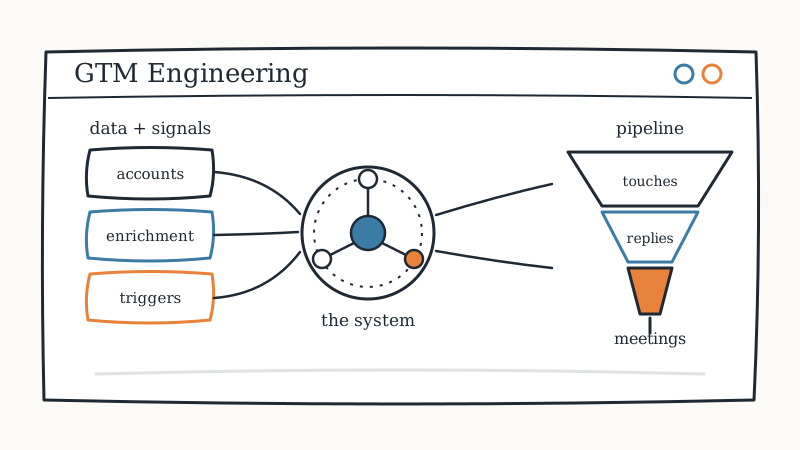
A GTM engineer is a technical go-to-market specialist who builds, automates, and maintains the systems that generate pipeline. Instead of sending outreach by hand, a GTM engineer designs the machine that sends it: the data pipelines that find and enrich accounts, the signal logic that decides who gets contacted and when, the sequences and agents that do the contacting, and the measurement layer that proves what worked. The role sits between revenue and engineering, and it became a named job title around 2024 as AI and APIs made it possible for one technical person to produce the pipeline output of an entire SDR pod.
This guide answers the questions buyers and candidates actually ask about the role, in the order they ask them.
What is a GTM engineer?
A GTM engineer is the person who treats go-to-market as a system to be built rather than a quota to be grinded. They own the plumbing: data in, qualified pipeline out.
The short definition: a GTM engineer uses data, APIs, automation, and AI to turn a target market into a repeatable flow of qualified conversations.
Three things distinguish the role from everything that came before it:
- They build, they do not just operate. A GTM engineer writes the automation, calls the API, and designs the workflow. They are not configuring someone else’s SaaS dashboard and waiting on a vendor roadmap.
- They own an output metric, not a ticket queue. The measure of a GTM engineer is qualified pipeline created, not requests closed.
- They work across the whole funnel. Sourcing, enrichment, routing, outreach, reply handling, and reporting are all in scope, because a break anywhere in that chain shows up as a pipeline miss.
What does a GTM engineer actually do day to day?
The job decomposes into five recurring workstreams.
1. Audience and data engineering. Define the ideal customer profile precisely enough to be queryable, then build the pipeline that produces matching accounts and contacts. In practice this means stitching multiple data sources together, because no single provider has complete coverage. Our guide to waterfall contact enrichment covers the pattern GTM engineers use to chain providers in cost order. At GroomLead the sourcing layer runs on Triguna, which returns current firmographic and contact data from a company or profile identifier in a single API call, so lists are built from live data rather than a stale export.
2. Signal and trigger logic. Decide what event makes an account worth contacting this week: a job change, a hiring post, a funding round, a technology install, a site visit. Then write the rules that convert that signal into an action. This is where most of the leverage lives, because timing beats copy almost every time.
3. Outreach automation. Build the sequences, the branching logic, and increasingly the AI agents that execute the touches. Research-and-write work that used to require a human per account is now handled by agents like VSDR, which researches each prospect and runs personalized email and social touches at a controlled, human cadence. The GTM engineer’s job is to configure the guardrails, not to write every email.
4. Response and handoff systems. A reply that sits for six hours is a wasted reply. GTM engineers build the triage layer so inbound replies get classified, drafted, and routed fast. Underfive.ai handles that classification and drafting within minutes, and CAM keeps the resulting conversations and account context organized so nothing falls between a sequence and a CRM record.
5. Measurement and iteration. Instrument every step, find the constraint, fix the constraint, repeat. If you do not know your reply-to-meeting conversion by segment, you are guessing. See our breakdown of the outbound metrics that actually predict revenue.
GTM engineer vs sales ops vs RevOps vs SDR: what is the difference?
These four roles are routinely confused. The clean distinction is what each one owns and what each one is measured on.
| Role | Primary job | Measured on | Builds things? |
|---|---|---|---|
| GTM engineer | Builds the pipeline generation system end to end | Qualified pipeline created | Yes, writes automation and API integrations |
| Sales ops | Keeps the sales process and tooling running | Process adherence, data hygiene, rep productivity | Configures tools, rarely builds |
| RevOps | Aligns marketing, sales, and CS systems and forecasting | Forecast accuracy, funnel efficiency across teams | Owns architecture, delegates building |
| SDR | Has conversations with prospects | Meetings booked, activity | No, executes inside the system |
A simpler way to hold it: RevOps decides what the revenue architecture should be, sales ops keeps it running, the GTM engineer builds the parts that generate demand, and the SDR works the output. A small company often has one person wearing all four hats. A scaling company that collapses GTM engineering into sales ops usually ends up with clean dashboards and no pipeline.
What skills does a GTM engineer need?
The skill set is deliberately hybrid. Pure engineers build elegant systems that target the wrong accounts. Pure sellers build clever campaigns that cannot scale past 200 contacts a week.
- API and data literacy. Comfort with REST APIs, JSON, webhooks, and pagination. You do not need to ship production software, but you need to read docs and debug a failed payload.
- SQL and spreadsheet fluency. Most GTM data problems are joins and deduplication problems.
- Automation platforms. Workflow tooling such as n8n, Make, Zapier, or Clay, plus whatever your sequencer and CRM expose.
- Light scripting. Python or JavaScript for the transformations no-code tools cannot express cleanly.
- Prompt and agent design. Writing prompts that produce consistent, on-brand output at volume, and knowing when to constrain a model rather than trust it.
- Deliverability fundamentals. Domain authentication, warmup, volume pacing, and list hygiene. See our inbox placement guide for the specifics that break campaigns.
- Commercial judgment. The ability to look at an ICP and say “this segment will never convert” before building three weeks of automation for it.
A useful hiring heuristic: ask a candidate to describe the last system they built that produced a meeting. If the answer is a tool they bought rather than a thing they wired together, they are a sales ops candidate, not a GTM engineer.
What does a GTM engineer’s tech stack look like?
GTM engineers think in layers, not logos. The tools change constantly, the layers do not.
| Layer | Purpose | What breaks without it |
|---|---|---|
| Data sourcing | Produce accounts and contacts that match the ICP | You target the wrong market precisely |
| Enrichment and verification | Make records current and deliverable | Bounces spike and personalization goes stale |
| Signal detection | Decide who to contact now | Perfect message, wrong week |
| Orchestration | Move records between systems on rules | Manual CSV work consumes the whole role |
| Outreach execution | Send email, LinkedIn, and calls at cadence | Touches get dropped and coverage collapses |
| Reply handling | Classify and respond fast | Interested prospects go cold waiting |
| Relationship graph | Track champions and past buyers across job changes | You re-cold-email people who already love you |
| Reporting | Attribute outcomes to segments and steps | You optimize on vibes |
That last-but-one layer is underrated. A past champion who changes companies is the single warmest outbound target available, and tracking that automatically is why Champions exists as its own layer rather than a CRM field. For the full stack breakdown by layer, see our outbound sales tech stack guide.
How much does a GTM engineer make in 2026?
Compensation varies by market and company stage, but the 2026 ranges we see in US B2B SaaS cluster like this:
| Level | Base salary | Typical total comp |
|---|---|---|
| Junior or first GTM hire with technical skills | 85,000 to 110,000 USD | 100,000 to 130,000 USD |
| Mid-level GTM engineer | 120,000 to 150,000 USD | 140,000 to 185,000 USD |
| Senior or lead GTM engineer | 160,000 to 200,000 USD | 190,000 to 250,000 USD |
The premium over a traditional sales ops salary exists because the output is measured in pipeline, and a GTM engineer who builds a working system typically replaces two to four SDR seats worth of sourcing and research labor. The comparison math is in our AI SDR vs human SDR cost breakdown.
When should you hire a GTM engineer?
Hire one when all three of these are true:
- You have found a repeatable segment. A GTM engineer scales what works. If you still do not know who buys, you need a founder in the market, not an automation build.
- Manual work is the constraint. When reps spend more than a third of their week on list building, research, and data cleanup, there is a system to build.
- Someone owns the number. The role needs a pipeline target. Without one it drifts into being an internal tools helpdesk.
Do not hire one to fix a messaging problem, a product-market-fit problem, or a leadership problem. Automation makes a broken motion fail faster.
How do you build a GTM engineering function?
There are three realistic paths.
Hire in-house. Best when GTM is your core differentiator and you can afford twelve weeks of ramp plus the tool budget. Expect a long search; the supply of genuinely technical GTM people is still thin.
Upskill an existing operator. Your sharpest sales ops or SDR lead with real curiosity about APIs is often the fastest path. Give them a pipeline target, a tool budget, and protected build time.
Outsource the build and run. Fastest route to output, and the right call when you want pipeline this quarter rather than a hiring project. This is what GroomLead does: we build the data, signal, outreach, and reply systems, run them, and hand over a documented machine instead of a slide deck.
Frequently asked questions
Is GTM engineer just a new name for a growth hacker? No. Growth hacking was experiment-led and usually consumer and self-serve. GTM engineering is systems-led and primarily B2B, focused on building durable, auditable pipeline infrastructure rather than one-off viral tactics.
Do GTM engineers need to know how to code? Not to a software engineering standard. They need to read API documentation, write SQL, debug a webhook, and script light transformations. Many effective GTM engineers do 80 percent of their work in no-code orchestration tools and reach for Python only when the tool cannot express the logic.
Does a GTM engineer replace SDRs? No, it changes what SDRs do. The engineer removes list building, research, and data entry from the SDR’s week, so the humans spend their hours on live conversations and the calls that require judgment. The result is usually fewer SDRs doing higher-value work rather than zero SDRs.
Is GTM engineering only for large companies? No. The role has the highest leverage at seed to Series B, where one technical operator can cover the sourcing and outreach work of a team that the company cannot yet afford to hire.
What is the difference between a GTM engineer and a marketing ops manager? Marketing ops owns the demand capture and nurture systems, mostly inbound: forms, scoring, campaign attribution, and the MAP. GTM engineering is weighted toward demand creation, mostly outbound: sourcing, signals, and proactive outreach. The two overlap in routing and reporting.
How do you measure a GTM engineer? On pipeline created from the systems they own, plus efficiency metrics such as cost per qualified meeting and the percentage of rep time spent in conversation versus preparation. Avoid measuring them on activity volume; that incentivizes spam.
The bottom line
A GTM engineer is a builder who happens to work on revenue. The role exists because the leverage in B2B go-to-market shifted from how many people you can hire to how well you can wire data, signals, and AI agents into a system that produces conversations. In 2026 the companies winning competitive markets are not the ones with the biggest SDR teams. They are the ones whose go-to-market runs like infrastructure: instrumented, debuggable, and improving every week.
If you would rather have that system built and run for you than spend two quarters hiring for it, that is exactly what GroomLead does.
Ready to engineer your own GTM system?
GroomLead engineers outbound systems for B2B teams, and builds the tools inside this post.
Book Strategy Call