Trade Show and Conference Lead Follow-Up in 2026: How to Turn Badge Scans Into Booked Meetings
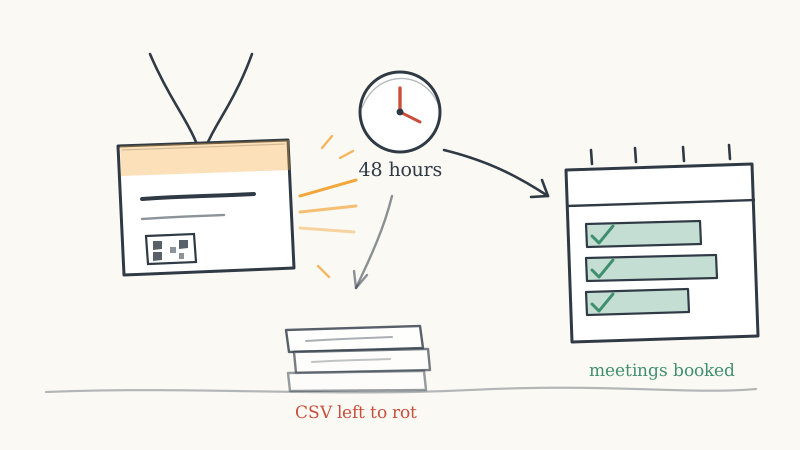
The expensive part of a trade show is not the booth. It is the two weeks after it.
A mid-size B2B company will spend $30,000 to $80,000 on a single industry conference once you count the booth space, the build, flights, hotels, swag, and the four people who were not selling anywhere else that week. They will come home with 400 badge scans. Then those 400 scans sit in a spreadsheet until someone finds a free afternoon, by which point the buyer has been home for eleven days, has forgotten which of the nine vendors in that aisle you were, and has already taken a call with the competitor who emailed on Tuesday.
That is not a lead quality problem. That is a follow-up operations problem, and it is fixable with a system that is decided before anyone gets on a plane. At GroomLead we run post-event outbound as a scheduled motion with the sequences, the triage rules, and the reply coverage built in advance, and this post is the playbook we hand to clients two weeks before the show.
Short answer
How should you follow up on trade show leads? Triage every scan into three tiers by the quality of the actual conversation, not by job title. Tier one (a real conversation with a stated problem) gets a personal, specific reply within 24 hours, ideally from the person who stood there talking to them. Tier two (a short booth exchange or demo watcher) gets a reference-to-the-event sequence inside 48 hours. Tier three (a swag scan with no conversation) goes into standard nurture and gets worked as cold outbound with an event-flavored opener, never as a warm lead.
How fast does it need to go out? First touch within 48 hours of the show closing, because that is the window where the attendee still remembers the booth. Conversion on event leads degrades sharply after the first week and the badge-scan list is effectively cold by week three.
Why do most event leads never convert? Because the list is treated as one undifferentiated batch, the first email goes out eight or more days late, and the replies that do come back land in an inbox nobody is watching while the team catches up on the work they missed while travelling.
Why conference leads decay faster than normal inbound
An event lead has a short shelf life for a specific reason: its only real asset is a shared memory, and memory is the thing that decays.
A normal inbound lead is attached to a durable artifact. Someone downloaded a guide, visited a pricing page, filled in a form. The intent signal sits in your system and stays legible a month later. An event lead is attached to a four-minute conversation in a loud hall on the second of three days, during which the attendee also spoke with a dozen other vendors. The moment they cannot reconstruct which conversation was yours, your warm lead is a cold one with a worse first impression, because your email implies a relationship they do not remember having.
That is why the generic “great to meet you at the show!” email performs so badly. It fails to restore the memory it depends on. Everything below is built to restore it fast, while it still exists.
The underlying urgency math is the same one that governs inbound response, which we broke down in the speed-to-lead playbook: the first vendor to respond with something relevant captures a hugely disproportionate share of the meetings. Events just compress the window, because the buyer is comparison-shopping an entire category in one week.
Step 1: build the capture system before the event, not after
Almost every bad follow-up traces back to bad capture. If your only record of a booth conversation is a name and a company, your follow-up cannot be specific, and if it cannot be specific it cannot restore the memory.
Decide these before anyone travels.
Capture a conversation note on every scan, not just contact data. The badge scanner gives you the contact. The value is in the 10 words your rep adds: what the person actually said. “Running 6 SDRs, says deliverability tanked after Google update” is a follow-up email. “VP Sales, Acme Corp” is not.
Standardize a tier field at the point of capture. Three options, chosen in the moment by the person who had the conversation, while they still remember it. Tier assignment made a week later from a spreadsheet is guesswork.
Agree who owns the reply. Name the specific person who will send each tier’s first touch, before the event. “The team will divide them up” means nobody sends anything until Thursday.
Pre-write the sequences. All three tiers, drafted and loaded into your sending tool while you are still in the office. Writing copy on a Monday after three days of booth duty and a red-eye flight is how the eight-day delay happens.
Set the send date as a calendar commitment. Block the two hours. The follow-up is part of the event budget, not an optional extra.
A useful discipline: if the capture form cannot be filled in under 20 seconds, reps will not fill it in. One text field for the conversation note and one tier selector is the whole requirement.
Step 2: triage the list into three tiers
The single biggest lift in event follow-up is refusing to treat 400 scans as one list. Here is the split and what each tier actually gets.
| Tier | What it means | Typical share of scans | First touch | Channel | Realistic meeting rate |
|---|---|---|---|---|---|
| 1. Real conversation | Discussed a specific problem, asked how it works, or asked about pricing | 5% to 15% | Within 24 hours | Personal email from the rep who spoke to them, plus LinkedIn | 25% to 40% |
| 2. Booth exchange | Brief talk, watched a demo loop, took a card, no stated problem | 25% to 35% | Within 48 hours | Sequenced email referencing the event, then LinkedIn | 5% to 12% |
| 3. Swag scan | Scanned for the raffle or the coffee, no conversation | 50% to 70% | Within 1 week | Standard outbound sequence with an event-aware opener | 1% to 3% |
Two things in that table matter more than the rest.
Tier one is small and it is where the money is. A 500-scan event might hold 40 genuine conversations. Those 40 deserve individually written emails, not a sequence. If your team only does one thing well, do this.
Tier three is cold, so treat it as cold. This is the most common error. A swag scan is a person who walked past your booth, not a prospect who engaged with you. Sending them a “following up on our conversation” email is both false and ineffective, and if they report it as spam you have paid for the privilege of damaging your sending domain. Qualify tier three against your lead qualification framework first, keep the ones that fit your ICP, and run them as normal outbound where the event is context rather than a claimed relationship.
A tier zero also exists and is worth naming: the competitor reps, students, job seekers, and vendors who scanned your badge. Suppress them explicitly. Nothing erodes a sales team’s faith in an event list faster than being told to call three agencies that sell the same thing you do.
Step 3: the 48-hour sequence that actually works
What follows is the tier two sequence, because tier one should be hand-written and tier three is just your standard cadence with an event opener. Tier two is where most of the volume and most of the recoverable value sits.
Touch 1, day 1 or 2: restore the memory
The entire job of the first email is to make the recipient remember which booth you were. Not to pitch.
Three ingredients, in this order:
- A concrete, physical anchor. Not “we met at the conference.” Something they can picture: the thing in your booth, where you were standing, what the session before it was. “We talked at the GroomLead booth by the north coffee station, right after the deliverability panel.”
- The specific thing they said. This is your capture note earning its keep. “You mentioned your reply rates were fine but nothing was getting to a meeting.”
- One small ask. A 15-minute call with a named reason, or a direct question they can answer in one line. Not “let me know if you’d like to learn more.”
Keep it under 120 words. Plain text. No attachments, no deck, no video embed. Subject lines that work here are short and literal, and the event name does real work: “the north coffee station booth” or “re: your reply-to-meeting gap.”
What to cut: the company boilerplate paragraph, the list of everything you do, and the phrase “circling back” on a first email.
Touch 2, day 4 or 5: give them something useful
The second touch should be worth opening whether or not they are buying. Send the one artifact that directly addresses the problem they named at the booth: a teardown, a benchmark, a short how-to. No ask attached beyond an implicit one.
This touch exists because most people who meant to reply to touch one did not, and a second email that only says “just bumping this” gives them nothing to respond to.
Touch 3, day 8 to 10: a specific, low-friction ask
Now make the meeting ask concrete and easy. Two proposed times, or a direct link, plus one line on exactly what the call will cover. Reference the event once more, briefly.
Touch 4, day 14 to 18: the honest close
A short note that offers to stop, and names the alternative. “Sounds like this is not a now problem. Want me to check back after the new quarter starts?” This gets a meaningful number of replies, because it is easy to answer and it does not pretend.
Then stop the event framing
After roughly three weeks, the event has stopped being relevant context. Move anyone who has not replied into your standard nurture or signal-based outbound and let a future trigger bring them back. Continuing to reference a show from last month reads as a team with nothing new to say. The structure for that longer motion is the same multichannel cadence we describe in the outbound sales cadence guide.
Step 4: cover the replies, because this is where event ROI leaks
Here is the failure that costs the most and gets discussed the least.
Post-event follow-up produces a reply spike. You send 400 messages inside 48 hours, and unlike a steady-state drip, the responses all arrive in the same two days, into a team that just got back from a week away and is already behind. Positive replies sit for a day. Out-of-office auto-replies, wrong-person forwards, and “talk to my colleague” referrals get skimmed and lost. The meetings that the booth actually earned quietly fail to get booked.
Three fixes.
Consolidate the inboxes before the spike. Event replies arrive across every mailbox you sent from, plus LinkedIn, plus whatever address was on the badge scanner. Watching five places during the busiest reply window of the quarter does not work. Underfive.ai gives you a unified inbox for every sending account, with AI inbox agents that label replies, draft responses in under 5 minutes, and book meetings, which is exactly the shape of problem a reply spike is: high volume, time-critical, and spread across accounts.
Pre-sort the reply categories. Decide in advance what happens to each type: interested, referral to someone else, out of office until a date, not now with a timeline, hard no. Each needs a default action and an owner. Our reply management playbook covers the full taxonomy, and it matters more during an event spike than at any other time.
Staff the two days, explicitly. The 48 hours after the sequence goes out needs someone whose actual job that day is replies. Not “as well as their normal work.”
Step 5: work the long tail with signals for 90 days
Most event leads are not buying this month. That is not a failure of the event, it is the normal shape of a conference audience, and the teams that get real ROI from events are the ones who keep the list alive after the follow-up window closes.
The move is to stop pushing and start watching. An event list is an unusually high-quality seed population: these are people who physically travelled to a conference about your category. When one of them does something that indicates timing, you want to know that day.
The signals worth monitoring on an event list:
- Job changes. An attendee who moves to a new company is a fresh opportunity with pre-existing familiarity with your category, and often a mandate to change tooling.
- Website activity. Someone from a company you scanned reading your pricing page three weeks later is a far stronger buying signal than the badge scan ever was.
- Hiring signals. A post-event job posting for the role that owns your problem means budget just appeared.
- Competitor connections and social activity. Public signs that an attendee is actively evaluating the category.
CAM covers exactly this surface: buying-signal intelligence across job changes, social listening, competitor connections, and website activity, turned into lead lists. Pointing it at your event list converts a decaying spreadsheet into a standing trigger feed, so the follow-up that matters most happens on the buyer’s timeline instead of yours.
This is also the point where the data itself needs maintenance. An event list ages like any other contact list, and the people on it are disproportionately likely to move. If you plan to work it for a year, it needs the same hygiene as any other segment, which we cover in the CRM data decay guide.
How to measure event ROI without lying to yourself
Most post-event reporting is designed to justify the booth. Four numbers tell the truth instead.
| Metric | How to calculate it | What it tells you |
|---|---|---|
| Cost per qualified conversation | Total event cost divided by tier one count | Whether the booth, the location, and the staffing worked |
| Follow-up latency | Median hours from show close to first touch, by tier | Whether your operations captured what the booth earned |
| Event-sourced pipeline | Pipeline value from event-origin contacts, 90-day window | The only number a CFO cares about |
| 90-day meeting rate by tier | Meetings booked divided by scans, split by tier | Which tier deserves next year’s effort |
Two reporting disciplines make these usable.
Tag origin at the contact level with the event name, and keep the tier. “Trade show” as a lead source is useless after your second event. You need to be able to say that Conference A produced 38 tier one conversations and 9 closed deals while Conference B produced 110 swag scans and nothing.
Use a 90-day window, not a 2-week one. Reporting event ROI the week after the show systematically undercounts it and pushes teams to cancel events that were actually working. Reporting it a year later means the decision arrives after you have already rebooked.
And when meetings do get booked off an event list, protect them. Event-sourced meetings no-show at a higher rate than inbound ones, because the buyer’s enthusiasm was partly situational and the conference is now a fading memory. The confirmation sequence in our no-show playbook applies directly.
The seven mistakes that waste a booth
- Sending the first email more than a week out. The single largest cause of wasted event spend. The memory is gone and a competitor got there first.
- One generic blast to all scans. Optimizes for the 60% who do not care and insults the 10% who do.
- Treating swag scans as warm leads. Produces spam complaints, domain damage, and a sales team that stops trusting event lists.
- No conversation note captured. Guarantees a generic follow-up, which guarantees a low reply rate.
- Nobody owning the reply window. You generate the interest and then fail to be there when it arrives.
- Dropping the list after three weeks. Abandons the 70% of the audience whose timing simply was not now.
- Reporting ROI at two weeks. Kills events that worked and keeps events that did not.
Frequently asked questions
How soon after a trade show should I email leads? Tier one within 24 hours, tier two within 48 hours of the show closing, tier three within a week. The practical constraint is memory: after about a week most attendees cannot reliably place which booth you were, and your advantage over a cold email disappears.
Should the rep who met them send the follow-up, or should it come from a sequence? For tier one, the rep who had the conversation, hand-written. The specificity is the entire value and it cannot be templated. For tiers two and three, a sequence is correct and more reliable, because consistency beats intention when everyone is behind after a week of travel.
Is it legal to cold email people who scanned my badge? Scanning a badge at your booth generally constitutes an exchange of business contact details in a B2B context, which most regimes treat favorably, but the rules differ by jurisdiction and the safe practice is the same either way: accurate sender identification, a working opt-out, real suppression, and no claiming of a conversation that did not happen. Check your own counsel for GDPR and CASL specifics before emailing EU or Canadian attendees.
What reply rate should I expect from a trade show list? Tier one commonly lands 40% or higher because it is a genuine warm follow-up. Tier two typically runs 10% to 20%. Tier three behaves like cold outbound to a lightly qualified list, so 2% to 6%. Any vendor quoting one blended number for an event list is averaging across tiers that have nothing in common.
We came back with 600 scans and no notes. What now? Do not pretend otherwise. Qualify the list against your ICP, drop the obvious non-fits and competitors, and run what is left as cold outbound with an honest event-aware opener that references the conference rather than a conversation. Then fix the capture process before the next show, because that is the actual problem.
Do we even need the booth, or could we just work the attendee list? Many teams get better economics from the attendee list alone, especially at large shows. The booth earns its cost only if it reliably produces tier one conversations. If the last two events produced fewer than 20 real conversations each, the booth is the line item to question, not the follow-up.
The system beats the hustle
Every part of this playbook is decided before the event, not after. The tiers, the sequences, the owner of each first touch, the person watching the inbox during the spike, the signals you will monitor for the next 90 days, the four numbers you will report at day 90.
That front-loading is the whole trick. Post-event is the single worst moment to be designing a follow-up motion, because everyone is tired, behind, and operating against a clock that started the moment the hall emptied. Teams that lose event ROI rarely lose it to bad leads. They lose it to a system that did not exist yet when it was needed.
If you want the post-event motion built and run as part of a standing outbound system, with the sequences pre-loaded, the reply window covered, and the long tail on signal monitoring, GroomLead builds and operates exactly that, on pay-per-lead pricing rather than a retainer. Book a call before your next show, not after it.
Ready to engineer your own GTM system?
GroomLead engineers outbound systems for B2B teams, and builds the tools inside this post.
Book Strategy Call