Speed to Lead in 2026: How the 5-Minute Response Window Wins More Sales Meetings
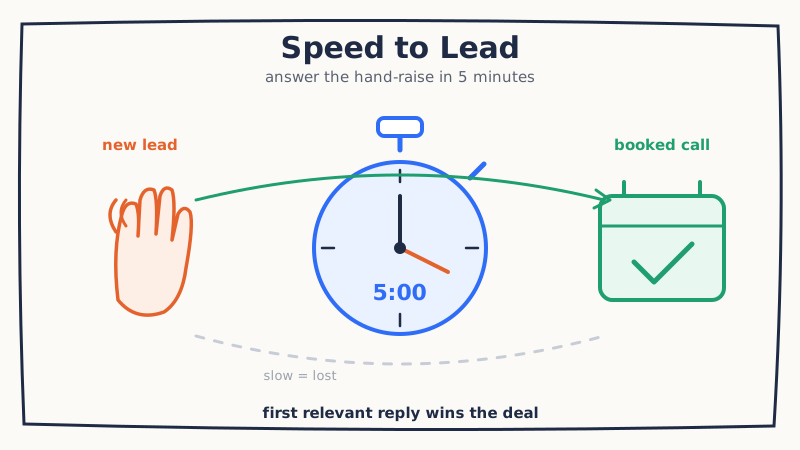
Short answer: Speed to lead is the elapsed time between a prospect raising their hand and your first human-quality response. In 2026 it is the single cheapest lever in the entire funnel, because the buyer’s intent is at its absolute peak in the first five minutes and decays fast after that. Teams that reply inside five minutes are dramatically more likely to connect and qualify the lead than teams that reply in thirty, and most companies still take hours or days. Win the first five minutes on every inbound lead and you will book more meetings from the exact same traffic, with no extra ad spend, no new list, and no clever new copy.
The rest of this post covers what speed to lead actually is, the response-time data that makes it non-negotiable, why almost everyone is slow, and the exact stack GroomLead uses to answer every lead in minutes around the clock.
What is speed to lead?
Speed to lead (also called lead response time) is the clock that starts the instant someone submits a form, books a demo, replies to a sequence, or otherwise signals interest, and stops when a real, relevant response reaches them. Not an autoresponder that says “we got your message.” A response that moves the conversation forward: answers their question, offers a time, or asks the one thing you need to qualify them.
The metric matters because intent is perishable. A person who fills out a demo form is, in that moment, actively thinking about their problem and comparing options. Ten minutes later they have switched tabs, joined a meeting, or filled out three of your competitors’ forms too. The window where they are primed to talk is measured in minutes, and every minute you wait, someone else is closing it.
That is the whole idea, and it is why teams working with GroomLead treat response time as a first-class GTM metric, tracked and optimized like conversion rate or cost per lead.
Why does lead response time matter so much?
The research here is old, consistent, and brutal. The landmark Lead Response Management study found that the odds of qualifying a lead drop by roughly ten times when you wait ten minutes instead of five, and companies that reach a lead within five minutes are far more likely to connect and to qualify than those that wait even thirty. Follow-up studies across the last decade keep landing in the same place: faster is better, and the drop-off is steepest in the very first minutes.
Three forces are stacking on top of each other in 2026:
- Buyer patience is shorter than ever. Prospects expect the same instant response from B2B vendors that they get from every consumer app. A next-day email reads as “they do not want my business.”
- More of the funnel is self-serve. By the time someone raises a hand, they have already researched you. They are ready to talk now, not to be nurtured for two weeks.
- Your competitors are getting faster. As automated response tooling spreads, “we usually reply within a day” is no longer average. It is last place.
The punchline: response speed is not a nicety layered on top of a good funnel. It is a multiplier on every dollar you already spend to generate the lead.
Why are most teams still slow?
If the data is this clear, why does the median company still take hours? Because speed to lead is an operations problem disguised as a sales problem. The usual culprits:
- Business-hours coverage. A lead that arrives at 7pm or on a Saturday sits until the next working morning, and a huge share of inbound arrives outside 9-to-5.
- Manual routing. The lead lands in a shared inbox or a CRM queue, waits to be assigned, waits to be noticed, then waits for the rep to have a free moment.
- Context gaps. The rep has to look up the account, figure out what the lead wants, and draft a reply from scratch, so even an “instant” human response takes twenty minutes of real work.
- No measurement. Teams that do not track response time cannot improve it. Most have never once looked at the number.
Every one of these is fixable. None of them requires hiring more reps. They require wiring detection, enrichment, routing, and first-touch response into a system that never sleeps and never gets distracted.
The 5-minute speed-to-lead playbook
Here is the loop GroomLead builds for inbound, and the layer that owns each step.
1. Detect the signal the instant it happens
The clock is already running when the form fires, so detection has to be real time, not a batch export you check twice a day. Every inbound source (forms, demo requests, sequence replies, and high-intent events like a repeat pricing-page visit or a past champion changing jobs) needs to trigger the loop immediately. Job-change signals in particular are worth wiring in, which is exactly what Champions does: it watches your customers and champions for role changes and surfaces the warm ones the moment they move.
2. Enrich and route before a human touches it
A raw lead is just an email address. Before anyone responds, the account should be enriched, scored for fit, and routed to the right owner automatically, so no lead ever waits in a queue to be assigned. Triguna sits in this middle layer, enriching each inbound event and pushing a clean, scored, correctly-routed record into your response tooling so the first touch is instant and informed.
3. Respond in under five minutes, every time
This is the step everyone gets wrong, because humans cannot cover nights, weekends, and simultaneous spikes. The response has to be automated in a way that still feels personal and context-aware. This is the entire reason we run Underfive on inbound: it answers interested leads with a relevant, context-aware reply in under five minutes, day or night, so the buyer is talking to you while their intent is still at its peak instead of waiting until tomorrow.
4. Book the meeting while intent is hot
The goal of the fast first touch is not just to reply, it is to convert the moment into a booked call. The response should carry the ask (a proposed time, a scheduling link, a qualifying question) so the conversation moves straight toward the calendar rather than stalling.
5. Hand warm conversations to a human to close
Speed gets you the conversation. People still close deals. Once a lead is engaged and qualified, it goes to a rep with full context. For teams that want the whole detect-enrich-respond loop running without building it in-house, VSDR chains those steps into an AI sales rep that works inbound and outbound around the clock and hands the warm, qualified conversations to a human to finish.
Speed to lead for outbound, not just inbound
Speed to lead is usually framed as an inbound metric, but the same clock governs outbound. When a prospect replies to a cold sequence, that reply is an inbound lead with a five-minute window of its own. A reply that sits for a day is the outbound version of a form left unanswered.
The same is true of external events. When a competitor raises prices, sunsets a product, or has an outage, the accounts frustrated with them are briefly in-market, and reaching them first is a speed game. Monitoring those competitor changes continuously is the job of GetCam, which watches competitor sites and pricing so your rep can be the first relevant message in the inbox while the buyer is still annoyed. In both cases the rule is identical: the value of the touch decays by the minute, so the system that responds fastest wins.
How to measure and improve your speed to lead
You cannot fix what you do not measure. Start here:
- Instrument the clock. Log a timestamp when each lead is created and when the first real response goes out. The gap is your speed to lead. Track the median and, more importantly, the 90th percentile, because your slowest leads are where the money leaks.
- Segment by time of day. Split business-hours response time from nights and weekends. The off-hours number is almost always the disaster, and it is usually a large slice of total volume.
- Set a five-minute target and automate toward it. No human team can hit a five-minute median on its own across every hour. Automate detection, routing, and first touch so the target is structural, not heroic.
- Review weekly. Put the number next to conversion rate in your GTM review. When response time drops, watch booked meetings climb from the same lead volume.
The bottom line
Speed to lead is the rare growth lever that costs almost nothing and compounds immediately. You are already paying to generate every lead. Answering it in five minutes instead of five hours is how you actually get paid for that spend. The teams pulling ahead in 2026 have stopped treating the first response as an afterthought and started treating it as the moment the deal is won or lost. If you want help wiring the detection, enrichment, routing, and instant-response layers into one system, that is exactly the kind of GTM engineering GroomLead does.
Frequently asked questions
What is a good speed-to-lead time? Under five minutes for the first response. That is the threshold where the research shows the biggest jump in connect and qualification rates, and it is fast becoming the baseline buyers expect rather than a competitive edge.
Is an autoresponder the same as fast speed to lead? No. A generic “we received your message” auto-reply does not move the conversation forward, so it does not count. The response has to be relevant and context-aware: it should answer, qualify, or offer a time. The goal is a real first touch in minutes, not just any email in seconds.
Does speed to lead apply to outbound? Yes. When a prospect replies to a cold email or a competitor event puts an account in-market, that is a high-intent lead with the same short window. Responding fast to sequence replies and event triggers matters as much as answering an inbound form.
How do I hit a five-minute response time overnight and on weekends? You automate it. Human teams cannot cover every hour, so detection, routing, and the first touch have to run without a person in the loop, escalating to a rep only once the lead is engaged and qualified.
Will faster responses hurt quality? Only if the fast response is generic. Done right, speed and quality reinforce each other, because an enriched, well-routed, context-aware first touch is both instant and more relevant than a slow reply drafted from a cold start.
Ready to engineer your own GTM system?
GroomLead builds the outbound infrastructure behind 100+ agencies, and the tools inside this post.
Book Strategy Call