Pay-Per-Lead vs Retainer in 2026: How B2B Lead Gen Pricing Models Compare on Cost Per Meeting
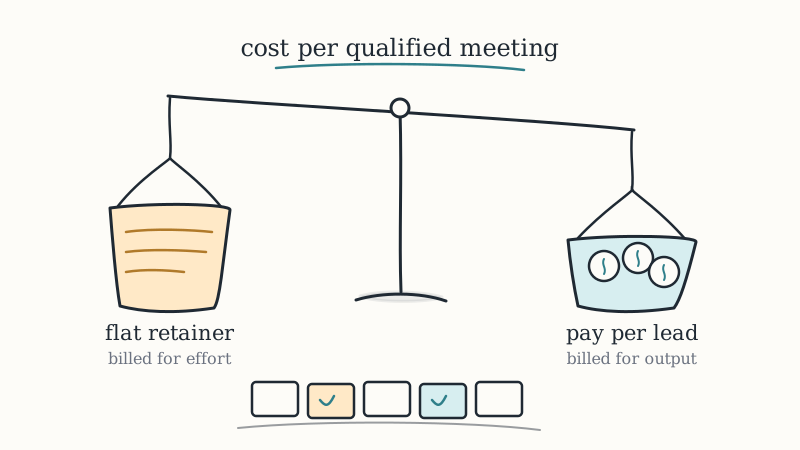
Every B2B lead generation contract is a bet about who absorbs the risk of the system not working.
A retainer says the buyer absorbs it. You pay a fixed monthly fee, the agency runs the plays, and if the quarter produces nothing you have still paid for the quarter. Pay-per-lead says the vendor absorbs it. You pay per qualified output, and a bad month costs the vendor its own labor rather than costing you your budget.
Both models can be honest and both can be abused. The difference that matters is not the headline number, it is what the number is attached to. At GroomLead we price on pay-per-lead specifically because it puts our margin on the same side of the table as your pipeline, and this post is the comparison we walk prospects through before they sign anything, including the cases where a retainer is genuinely the better buy.
Short answer
Which B2B lead generation pricing model is cheaper in 2026? Measured on fully loaded cost per qualified meeting, pay-per-lead is usually the cheapest way to start and the most predictable way to scale, because you pay only for delivered output and the vendor carries tooling, domains, data, and labor cost. Retainers are cheaper per unit only once volume is high and consistent enough that the fixed fee divides down, typically above roughly 40 to 60 qualified meetings a month. In-house SDR teams have the lowest marginal cost per meeting at full productivity but the highest cost to reach it, because you pay salary, tooling, and management through a three to five month ramp that produces almost nothing.
The practical rule: pay-per-lead when you are still proving the motion, retainer when you need strategic control over a complex or regulated message, in-house when outbound is a permanent core competency and you can fund the ramp.
The four pricing models actually on the market
Most vendor proposals are a variation on one of four structures. Knowing which one you are reading changes which questions you should be asking.
| Model | How you are billed | Who carries the risk | Typical 2026 range |
|---|---|---|---|
| Retainer | Flat monthly fee for a scope of work | Buyer | $4,000 to $15,000 per month |
| Pay-per-lead | Per qualified lead or per booked meeting delivered | Vendor | $75 to $400 per lead, $300 to $800 per meeting |
| Hybrid | Reduced base fee plus per-output fee | Shared | $2,000 to $5,000 base plus per unit |
| In-house SDR | Salary, commission, tooling, management overhead | Buyer, entirely | $90,000 to $150,000 fully loaded per rep per year |
The ranges are wide because they bundle different things. A $5,000 retainer that includes data, sending infrastructure, copywriting, and a strategist is not comparable to a $5,000 retainer where you supply the list and the domains. Before comparing two numbers, make both vendors itemize what the fee covers.
Retainer
You buy capacity and expertise for a period. Good retainer agencies bring a named strategist, write genuinely differentiated messaging, and will tell you when your offer is the problem rather than your sequence.
The failure mode is effort theater. Because the fee is detached from output, a retainer can be fully satisfied by activity: sequences shipped, lists built, meetings attended. Six weeks of that is reasonable ramp. Six months of that is a subscription to a dashboard.
Pay-per-lead
You buy delivered output at a unit price. The vendor funds the data, the sending infrastructure, the copy, and the labor, and recovers it only on qualified delivery.
The failure mode here is definitional. Pay-per-lead is only as good as the word “qualified,” and a vendor with a loose definition can bill you for anyone who replied without saying no. We cover how to tighten that below, because it is where almost every bad pay-per-lead engagement goes wrong.
Hybrid
A smaller base fee covers fixed costs, with per-output pricing on top. This is the honest middle for engagements where the sales cycle is long or the target market is tiny, because a pure per-lead model on a 400-account total addressable market prices the vendor out of doing careful work.
In-house
You hire the function. The arithmetic people forget is ramp. A fully loaded SDR at $120,000 a year who takes four months to reach productivity has cost roughly $40,000 before delivering a reliable meeting, and that is before tooling. Our outbound pipeline math breakdown walks through how to reverse-engineer whether that ramp is affordable against your quota.
Comparing on cost per qualified meeting, not cost per month
Monthly fees are not comparable across models. Cost per qualified meeting is, and it is the only number that connects a vendor invoice to your pipeline target.
Here is the same quarter modeled three ways, assuming a target of 20 qualified meetings a month.
| Retainer | Pay-per-lead | In-house (1 SDR) | |
|---|---|---|---|
| Month 1 cost | $8,000 | $1,500 (5 meetings) | $10,000 + $1,500 tooling |
| Month 2 cost | $8,000 | $4,500 (15 meetings) | $10,000 + $1,500 tooling |
| Month 3 cost | $8,000 | $6,000 (20 meetings) | $10,000 + $1,500 tooling |
| Meetings delivered | 42 | 40 | 18 |
| Cost per meeting | $571 | $300 | $1,917 |
Two things fall out of that table. First, pay-per-lead wins decisively in the proving phase, because you are not paying for the vendor’s learning curve. Second, the retainer advantage only appears if you extend the model: at 60 meetings a month the same $8,000 retainer is $133 per meeting while pay-per-lead at $300 is still $300. Fixed fees divide down and unit prices do not.
So the real question is not which model is cheaper. It is whether you have enough volume and enough confidence in the motion to make a fixed fee divide down. Most teams do not yet, and buy a retainer anyway.
Where pay-per-lead goes wrong: the definition of “qualified”
A per-lead price is meaningless without a contractual definition of the unit. Before you sign, get these in writing.
The qualification criteria. Firmographic fit (industry, employee count, geography, revenue band), title or seniority band, and the specific buying signal or stated interest that makes this person a lead rather than a contact. “Replied positively” is not a criterion. “VP or above at a 200 to 2,000 employee manufacturer who asked for a call or pricing” is.
The rejection window and process. You need a defined period, 5 to 10 business days is standard, in which you can reject a delivered lead that misses criteria, plus a stated remedy: credit, replacement, or refund. A vendor who will not accept a rejection clause does not believe in their own qualification.
No-show treatment. If you are buying booked meetings rather than leads, decide now who eats a no-show. The defensible split is that the vendor owns confirmation and reminder sequencing and therefore owns the first no-show, and you own reschedules after a held conversation. Our no-show reduction playbook covers the mechanics either party would need to hold up their end.
Attribution rules. What happens when a pay-per-lead vendor books a meeting with an account your AE was already working? Define an exclusion list, refresh it monthly from your CRM, and agree that anything on it is unbillable.
Exclusivity and resale. Ask directly whether the same lead can be sold to another client. In some lead marketplaces that is the business model, and it means you are competing for attention with whoever else bought the record.
Teams that skip these do not get a cheaper engagement. They get an engagement where every invoice is a negotiation.
Where retainers go wrong: no output floor
The equivalent discipline on a retainer is an output floor. Not a guarantee, which few credible agencies will give, but a stated target with a consequence.
Ask for three things. A monthly qualified meeting target that both sides consider realistic. A review gate at 90 days where missing the target by more than some margin triggers either a fee adjustment or a clean exit. And named access, meaning you know which strategist is on your account and how often you get them, so you do not discover in month four that your account is run by a junior operator following a template.
Also insist on asset ownership. Domains, mailboxes, sequences, and the enriched list should be yours at the end of the engagement. An agency that keeps the sending infrastructure keeps your deliverability history, and you restart from zero with the next vendor.
What the price is actually covering
Vendor proposals rarely itemize, so the same number can hide very different scopes. Six cost layers sit underneath any outbound engagement, and whoever is not paying for a layer is assuming you will.
| Layer | What it covers | Rough monthly cost if you buy it yourself |
|---|---|---|
| Data and enrichment | Contact sourcing, waterfall enrichment, verification | $500 to $2,500 |
| Sending infrastructure | Domains, mailboxes, warmup, deliverability monitoring | $300 to $1,200 |
| Sequencing platform | Cadence execution and reporting | $200 to $1,000 |
| Signal and intent | Job changes, website activity, competitor monitoring | $400 to $2,000 |
| Reply handling | Inbox triage, response drafting, booking | $1,000 to $4,000 |
| Strategy and copy | Offer design, messaging, iteration | $2,000 to $6,000 |
Reply handling is the layer buyers consistently underprice, and it is the one that quietly destroys the economics of a cheap engagement. A sequence that generates replies into an inbox nobody is watching converts worse than a sequence that generates fewer replies into an inbox someone answers immediately. This is the problem Underfive exists to solve: it unifies every sending account into one inbox and runs AI inbox agents that label incoming replies, draft responses in under five minutes, and book the meeting, which means the reply handling layer stops scaling linearly with headcount. If you are evaluating a vendor whose per-lead price looks implausibly low, ask who is sitting on the inbox and how fast they answer. Our speed to lead analysis covers why the five minute window is the difference between a lead and a logged activity.
The signal layer is the other one worth paying for explicitly, because it changes the denominator rather than the numerator. Outbound priced per lead gets cheaper when the list is built from accounts already in motion. GetCam turns buying signals (job changes, social listening, competitor connections, and website activity) into lead lists, so the volume you are paying per unit for is aimed at accounts with a live reason to reply rather than at a flat export. A vendor pricing off signal-built lists can quote a lower unit price honestly, because their qualified rate is structurally higher.
Which model to pick
Match the model to where you actually are, not to where you want to be.
Choose pay-per-lead when you are validating a new segment, geography, or offer; you need pipeline this quarter rather than next; your finance team wants outbound as variable cost; or you have been burned by a retainer that produced activity reports.
Choose a retainer when your message requires deep technical or regulatory fluency that takes a dedicated team weeks to build; your total addressable market is small enough that volume-based pricing would incentivize spray; you are buying strategic GTM work rather than meeting volume; or you need an agency to own brand voice in a way per-unit pricing will not support.
Choose hybrid when sales cycles are long, deal sizes are large, and both sides need the engagement to survive a slow first quarter.
Choose in-house when outbound is permanent, you can fund a five month ramp without needing results from it, and you have an experienced manager already. Without that manager, an in-house team is the most expensive way to learn what a vendor already knows. The honest intermediate step is to run pay-per-lead first, learn which segments and messages work, then hire into a proven playbook instead of asking a new rep to discover it.
Avoid any vendor who will not define “qualified” in the contract, will not accept a rejection window, cannot tell you whose domains are being used, or quotes a per-lead price without asking a single question about your ICP. The last one is the clearest signal, because a unit price that does not depend on who you are selling to is a price for volume, not for leads.
Frequently asked questions
What is a good cost per lead for B2B in 2026? For qualified, ICP-matched B2B leads, $75 to $400 per lead is the common band, with enterprise and regulated verticals at the top end. Booked meetings run $300 to $800. Anything far below the band is usually a different unit being sold under the same word, such as an unverified contact record or a positive-sentiment reply.
Is pay-per-lead better than a retainer? For most teams starting or restarting outbound, yes, because risk sits with the vendor and cost scales with output. Retainers win on complex, low-volume, high-consideration motions and at high steady volume where the fixed fee divides down.
How do I stop paying for bad leads? Put the qualification criteria in the contract, take a 5 to 10 business day rejection window with a credit or replacement remedy, and keep a CRM-synced exclusion list so accounts already in play are unbillable.
Does pay-per-lead work for long sales cycles? It works for the top of the funnel regardless of cycle length, since you are buying qualified conversations rather than closed revenue. Where a long cycle argues for hybrid is when the vendor needs more than one quarter of patient nurture work before any unit is deliverable.
Who owns the sending domains and data? You should, in every model. Put domain, mailbox, sequence, and list ownership in the contract so deliverability history and enriched data transfer to you at the end of the engagement.
The one number to hold vendors to
Strip away the model names and every proposal reduces to the same question: what is the fully loaded cost of one qualified meeting with someone who matches our ICP, and who pays when that meeting does not happen?
Run every quote through that question. A retainer answers it with a division problem you can only solve in arrears. Pay-per-lead answers it on the invoice. That transparency is the actual argument for the model, more than the price itself.
If you want that number modeled against your own ICP and quota before you commit to anyone, talk to us. We will build the pipeline math with you, and if a retainer is the better fit for your motion, we will say so.
Ready to engineer your own GTM system?
GroomLead engineers outbound systems for B2B teams, and builds the tools inside this post.
Book Strategy Call