Outbound System vs Outbound Campaign: What Is the Difference in 2026?
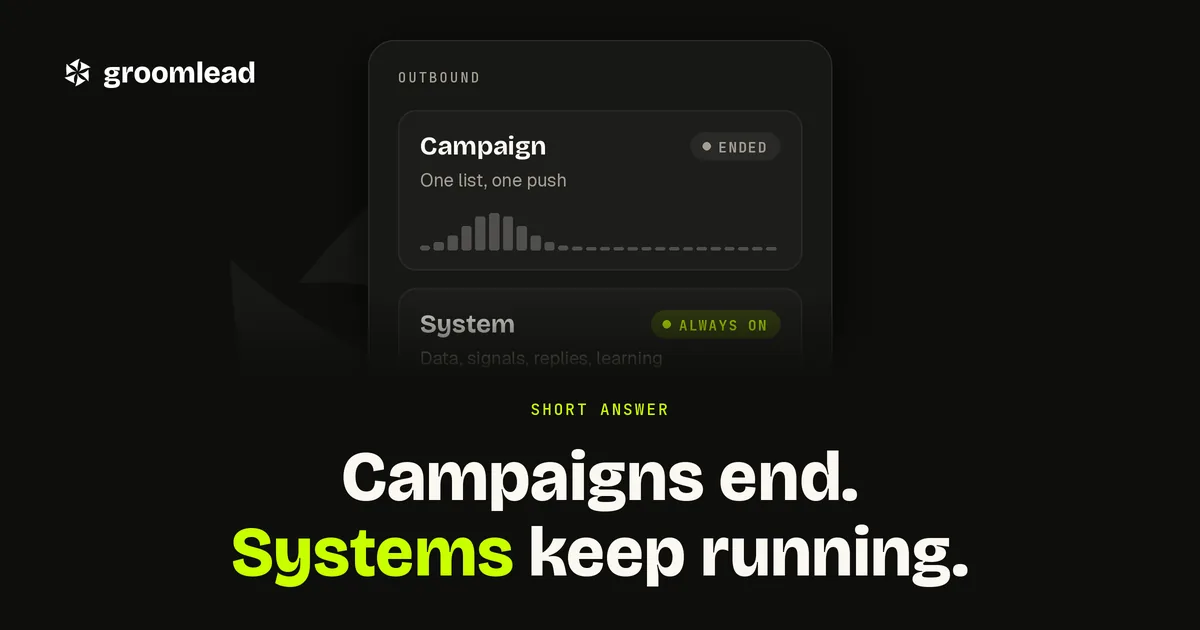
An outbound campaign is a single push: a list, a sequence, a send window, and a result. An outbound system is the always-on machine behind many campaigns: the data that keeps the list fresh, the signals that decide who gets contacted and when, the sequences, the reply handling, and the measurement that improves the next round. Campaigns end. A system keeps producing meetings after any one campaign finishes, because each round feeds what it learned back into the next.
Most teams run campaigns and call it a system. The difference shows up a few months in, when the campaign team is rebuilding a list from scratch and the system team is not.
Side by side
| Outbound campaign | Outbound system | |
|---|---|---|
| Lifespan | Starts and ends | Always on |
| List | Built once, decays from day one | Refreshed and enriched continuously |
| Timing | Whenever the campaign launches | Triggered by signals such as job changes or website activity |
| Replies | Handled by whoever has time | Routed into one inbox, sorted and answered fast |
| Learning | Lives in someone’s head | Written back into targeting and copy |
| Dependency | One person or one tool | Documented, so it survives staff changes |
What a system has that a campaign does not
A data layer. Contacts go stale quickly. A system re-verifies and enriches on a schedule instead of re-buying lists. See our guide to B2B data decay and CRM hygiene.
A signal layer. Instead of mailing everyone at once, a system contacts accounts when something changes. Our buyer intent signals playbook covers which signals are worth acting on. We use CAM to track job changes, social conversations, competitor connections and website activity in one feed.
A reply layer. Every reply from every sending account lands in one place, with a fast first response. We run Underfive.ai, a unified inbox with AI inbox agents that label replies, draft responses and book meetings.
A measurement layer. A system tracks the same metrics every week so changes can be compared. Our list of outbound sales KPIs is a starting point.
When a campaign is enough
Campaigns are the right tool for genuinely one-off moments: a product launch to a known list, a post-event follow-up, or a test of a new segment before you commit to it. The mistake is not running campaigns. It is running nothing but campaigns and expecting predictable pipeline.
Frequently asked questions
Is an outbound system just marketing automation? No. Marketing automation mostly nurtures people who already opted in. An outbound system finds and contacts people who have not, which adds sourcing, verification, signals and reply handling.
Do you need a GTM engineer to run an outbound system? Someone has to build and maintain it. That can be an in-house GTM engineer or a partner who engineers and operates it for you.
How long does it take to move from campaigns to a system? It depends on the state of your data and tooling. The usual order is data first, then reply handling, then signals, then measurement.
Can a system run on the tools we already have? Often, yes. The system is mostly the connections and rules between tools, not a single new platform. Our outbound sales tech stack guide covers the layers.
If you would rather have the system engineered and run for you, book a strategy call with GroomLead.
Ready to engineer your own GTM system?
GroomLead engineers outbound systems for B2B teams, and builds the tools inside this post.
Book Strategy Call