The Outbound Sales Tech Stack in 2026: The Six Layers That Turn a Cold List Into Booked Meetings
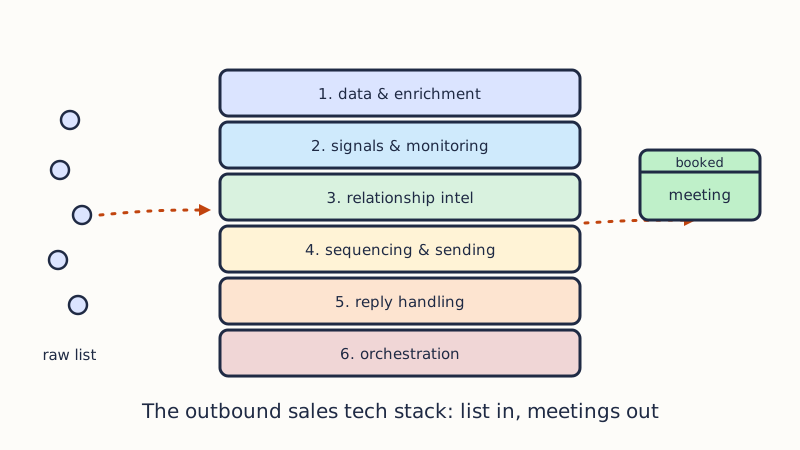
Most outbound problems get blamed on the wrong thing. Reps say the list is bad, leaders say the messaging is weak, and everyone buys another point tool to patch the gap. The real issue is usually the stack: a pile of disconnected tools that each do one job well and hand off badly, so leads leak between the seams. An outbound sales tech stack is not a shopping list. It is a pipeline where each layer feeds the next, from a raw list of companies to a meeting on a rep’s calendar. Here is how the stack fits together in 2026, layer by layer, and how GroomLead runs all six as one system.
What is an outbound sales tech stack?
An outbound sales tech stack is the connected set of tools that takes a target account, turns it into an accurate contact record, decides when and why to reach out, sends personalized messages across channels, handles the replies, and books the meeting. Each layer produces the input the next layer needs. When the layers are integrated, a company enters at the top and a qualified conversation comes out the bottom without a human re-keying data between steps.
The test of a good stack is not how many tools it has. It is how little manual work happens between them. A stack with six well-integrated layers beats a stack with fifteen tools that each require a rep to export a CSV and paste it somewhere else.
The six layers of the modern outbound stack
Every effective outbound motion, whether it runs on two tools or twenty, is really doing six jobs. Name them explicitly and you can see where your own stack is thin.
Layer 1: Data and enrichment
This layer answers a simple question: who exactly are we contacting, and is the record correct? It supplies firmographics (industry, size, business model), technographics (what they run), and contact details (verified role, email, and phone) for every account and person on the list. Everything downstream depends on this layer being current, because a perfect message sent to a stale contact still bounces.
Data is where most stacks quietly rot. B2B records decay fast as people change jobs and companies restructure, so a list that was clean six months ago is now full of dead contacts. The fix is enrichment at the moment of use rather than a one-time import. Triguna returns structured, current firmographic and contact data from a company domain or a LinkedIn profile in a single API call, so the record you act on is real today rather than a snapshot from last year.
Layer 2: Signals and monitoring
The second layer answers when and why to reach out. Fit tells you an account is worth targeting; a signal tells you now is the moment. Signals are observable events: a new funding round, a relevant hire, a product launch, a tech-stack change, or a shift on a competitor’s site. Outbound timed to a signal lands warmer because it references something real and recent instead of appearing at random.
Watching for those events by hand does not scale past a handful of accounts. CAM monitors target and competitor company websites for the changes that signal a buying window, such as new pricing, new pages, or messaging shifts, so a fresh trigger enters your stack as a dated event instead of something a rep has to notice. An account with a live signal should jump the queue ahead of a same-fit account with none.
Layer 3: Relationship intelligence
The warmest signal of all is a relationship you already have. When someone who trusted your product at a past company moves to a new one, that new account is pre-warmed the day the move happens. This layer tracks the people, not just the companies, so existing goodwill turns into new pipeline instead of being lost when a contact changes jobs.
Champions surfaces those job changes the moment they occur across your customers and past contacts, so a former user landing in a new role becomes a top-priority, pre-qualified lead that week. Relationship intelligence is the highest-conversion input in the entire stack, and most teams have no layer for it at all.
Layer 4: Sequencing and sending
This is the execution layer: turning a scored, enriched, signal-timed list into personalized messages delivered across email, LinkedIn, and phone at a human cadence. The job here is twofold. Write outreach that feels one-to-one, and send it in a way that protects deliverability so it actually reaches the inbox rather than the spam folder.
This is where hand-built outbound stalls, because researching and writing per lead does not scale by adding headcount. VSDR deploys an AI sales development rep that researches each account and writes individually personalized messages across the full multi-channel sequence at a controlled, human-like sending pace, so a well-built list gets worked thoroughly instead of blasted or sampled. The output of the first three layers is what makes this personalization accurate rather than generic.
Layer 5: Reply handling
Everything above exists to produce one thing: a reply. And a reply is the most perishable asset in outbound. Interest that is not answered within minutes cools within hours, and a positive reply routed to a rep who is asleep or busy quietly dies. This layer categorizes inbound responses, drafts the right reply, and moves an interested prospect toward a booked meeting before the moment passes.
Underfive.ai categorizes and drafts replies to inbound responses within minutes, separating the interested from the objections and the out-of-office noise, so an engaged prospect gets a fast, relevant answer while the interest is still warm. A stack that spends heavily on the first four layers and then lets replies sit for a day is pouring water into a leaky bucket.
Layer 6: Orchestration
The sixth layer is the one most stacks are missing entirely. Orchestration is the connective tissue that makes the other five behave like a single system: data flows into scoring, scoring plus signals sets priority, priority drives sequencing, replies feed back into the list, and outcomes tune the whole loop. Without it, you own six tools and a full-time job stitching them together with spreadsheets.
Orchestration is less about a single product and more about the process and ownership that keep the layers in sync. It is also the hardest part to build in-house, which is why many teams choose to have the entire stack run for them. That managed motion is exactly what GroomLead operates for its clients: the data, signals, relationship intel, sequencing, and reply handling assembled and run as one accountable pipeline.
How the layers fit together
The value is in the flow, not the individual boxes. A realistic path through the stack looks like this:
- A target account enters and Layer 1 enriches it into an accurate, current record.
- Layer 2 flags a live buying signal on that account, and Layer 3 notes that a former champion just joined it. Priority jumps.
- Layer 4 researches the account and sends a personalized, multi-channel sequence that references the real trigger.
- The prospect replies, and Layer 5 categorizes the interest and drafts a booking response within minutes.
- Layer 6 records the outcome and feeds it back, so the next similar account is scored and worked a little better.
Notice that no human exported a CSV, re-typed a contact, or noticed a signal by hand. That is what integration buys you: the reps spend their hours on live conversations instead of plumbing.
How to audit your current stack
You do not need every tool at once. You need every layer covered, even if lightly. Run this quick audit:
- Data: Is every contact verified at the moment of outreach, or are you working from an aging export? A high bounce rate is a Layer 1 failure.
- Signals: Do you reach out on observed events, or is timing effectively random? No signal layer means every send is a cold guess.
- Relationships: Do you know the week a past champion changes jobs? If not, you are leaving your highest-converting leads on the table.
- Sequencing: Is personalization real and consistent across the full list, or does quality drop after the first ten accounts? That gap is a Layer 4 capacity problem.
- Replies: How long does a positive reply wait for a response? Anything over an hour is lost pipeline.
- Orchestration: How many CSV exports and manual copy-pastes happen per week? Each one is a seam where leads leak.
The layer with the biggest gap is where your next dollar of budget belongs, not the layer that already works.
The build-vs-run decision
Assembling all six layers in-house is possible, but it is a real engineering and operations project: integrating the tools, maintaining the data flow, and owning the outcomes. For teams that want the pipeline without building the plumbing, the alternative is to have the whole stack run as a managed service. That is the model GroomLead is built on: the six layers assembled, integrated, and worked as one system, so you get booked meetings out the bottom instead of a tool subscription you have to operate.
The outbound stack checklist
- Cover all six layers: data, signals, relationships, sequencing, replies, and orchestration.
- Enrich and verify records at the moment of outreach, not once at import.
- Time outreach to observed signals, not to a random schedule.
- Track job changes so past champions become new-account leads the week they move.
- Keep personalization consistent across the full list, not just the first few accounts.
- Answer positive replies within minutes, because interest is perishable.
- Minimize manual handoffs between tools; every CSV export is a leak.
- Fund the weakest layer first, then tune the whole loop with outcome data.
An outbound tech stack is not a collection of logos on a slide. It is a pipeline, and it performs at the level of its weakest layer. If you would rather have that pipeline built, integrated, and run for you than assemble and operate it in-house, that is the exact system GroomLead runs for its clients every day.
Ready to engineer your own GTM system?
GroomLead builds the outbound infrastructure behind 100+ agencies, and the tools inside this post.
Book Strategy Call