Outbound Sales Cadence in 2026: The Multi-Channel Sequence That Books More B2B Meetings
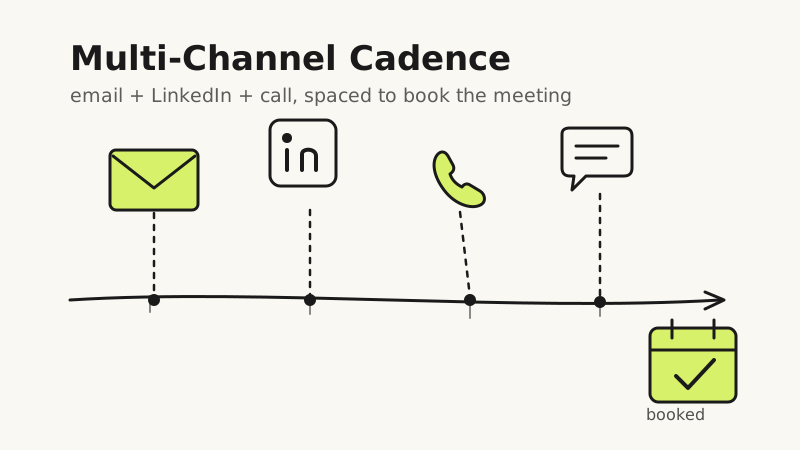
Most outbound programs do not fail because the copy is bad. They fail because the sequence gives up too early, hits the prospect on only one channel, or fires every touch on the same day and then goes silent. A cadence is the schedule that decides when and where each of those touches lands, and in 2026 it is the difference between a list that books meetings and a list that quietly burns out. Here is how we design outbound cadences at GroomLead for the programs we run.
What is an outbound sales cadence?
An outbound sales cadence is a predefined sequence of contact attempts, spread across channels and spaced over days, that a rep or an automated system follows to reach a prospect. A single cadence typically runs one to three weeks and includes a fixed number of touches: some by email, some by LinkedIn, some by phone. Each touch has a purpose, a channel, and a day assigned to it, so nothing is left to a rep remembering to follow up.
The point of writing the cadence down is consistency. When the sequence is defined in advance, every prospect gets the same disciplined follow-up, and you can measure which steps actually produce replies instead of guessing.
Why single-channel cadences stopped working
For years the default outbound cadence was five emails to the same address over two weeks. That still works occasionally, but three forces have eroded it:
- Inbox saturation. Buyers get more cold email than ever, so any single channel has a lower ceiling on attention than it did even two years ago.
- Deliverability pressure. Sending more email to compensate for low reply rates is exactly what gets a domain filtered. You cannot brute-force your way past a full inbox.
- Fragmented attention. The same buyer who ignores email answers a LinkedIn message, or picks up a call because they recognize the company name from an email they skimmed last week.
A multi-channel cadence solves all three. It spreads the same number of touches across email, LinkedIn, and phone, so no one channel carries the whole load, and it compounds familiarity: by the third touch the prospect has seen your name in two places, which lifts the response rate of every step after it.
The anatomy of a cadence that converts
A well-built outbound cadence has four levers. Get these right and the copy matters far less than people think.
1. Number of touches
Most B2B meetings that come from cold outbound take more than one attempt, and a large share come after the fourth touch, which is exactly where undisciplined teams quit. Plan for eight to twelve touches across two to three weeks. Fewer than that and you leave meetings on the table; many more and you tip from persistent into annoying.
2. Channel mix
Do not put all your touches on one channel. A durable mix is roughly half email, a third LinkedIn, and the rest phone or voicemail. Email carries the detail, LinkedIn adds a face and a lighter touch, and a call breaks the pattern when the written channels stall.
3. Spacing
Bunching touches together reads as desperation and trains the prospect to ignore you. Spread them out: a touch every two to three business days early in the sequence, tightening slightly in the middle when interest is warmest, then a clean break-up message at the end. Steady, human spacing also protects your sender reputation, which collapses when volume spikes.
4. Message escalation
Each touch should add something, not just resend the last one. Open with a relevant reason for reaching out, follow with a different angle or proof point, then a short question, then a genuine break-up that gives the prospect an easy out. Recycling the same paragraph four times is the fastest way to get muted.
A sample 14-day multi-channel cadence
Here is a starting template. Adjust the timing to your buyer, but keep the channel variety and the spacing.
- Day 1, Email: short, specific opener tied to a real trigger or observation about their company.
- Day 2, LinkedIn: connection request with a one-line, no-pitch note.
- Day 4, Email: a second angle, a relevant proof point or customer outcome.
- Day 6, Phone: a call plus a voicemail that references your emails.
- Day 8, LinkedIn: a short message with a single, easy-to-answer question.
- Day 10, Email: a case study or a resource, no hard ask.
- Day 12, Phone: second call attempt at a different time of day.
- Day 14, Email: the break-up message that closes the loop and invites a later reply.
Eight deliberate touches across three channels in two weeks beats fifteen emails to the same address every time.
Trigger the cadence off a real signal
The best cadence in the world underperforms if it starts from a stale, random list. Enrollment should be tied to a reason the prospect is worth reaching now.
Before anyone enters the sequence, verify and enrich the record so you are reaching a real, current person at the account. Triguna returns structured, current firmographic and contact data from a LinkedIn profile or company identifier in a single API call, so you can confirm a prospect still holds the role your list claims before you spend eight touches on them. Then layer intent on top: CAM watches competitor and target websites for the changes that signal a buying window, so you can start a cadence the week a prospect is actually in motion rather than at random. And your warmest trigger of all is a customer who moves companies, because they already trust you. Champions tracks those job changes and surfaces them as fresh, warm pipeline the moment a former champion lands somewhere new.
Personalize every touch without hand-writing every touch
The tension in outbound cadence is obvious: personalization lifts reply rates, but personalizing eight touches for hundreds of prospects by hand does not scale. In 2026 that is a solved problem. VSDR deploys an AI sales development rep that researches each prospect and writes individually personalized messages across the whole sequence at a controlled, human-like cadence, so every touch reads like it was written for that one buyer without a rep burning a day on it. That keeps the two things that usually trade off, reply rate and sending volume, both healthy at once.
Handle the replies fast, because a cadence’s job ends at the reply
A cadence exists to earn a response, and the moment it does, the clock starts. A prospect who answers on day six and hears nothing back until day eight has already cooled. Reply speed is both a conversion lever and, because engaged threads are a positive signal to mailbox providers, a deliverability one. Underfive.ai categorizes and drafts responses to inbound replies within minutes, so the interest a cadence generates turns into a booked meeting while it is still warm instead of decaying in an unread inbox.
Measure the cadence, not just the campaign
You cannot improve a cadence you do not instrument. Track these per step and per channel:
- Reply rate by touch number, so you see whether touches four through eight are earning their place or just adding noise.
- Channel contribution, so you know whether LinkedIn or phone is actually pulling its weight for this audience.
- Positive reply rate, not just any reply, because a cadence tuned for volume can generate a lot of polite declines.
- Meetings booked per hundred enrolled, the only number that ties the whole sequence to pipeline.
Kill the steps that never produce replies, double down on the channel that does, and re-test the spacing every quarter as your buyers’ habits shift.
A quick-start cadence checklist
- Plan eight to twelve touches across two to three weeks, not four emails over one.
- Split touches across email, LinkedIn, and phone rather than leaning on a single channel.
- Space touches every two to three business days and end with a clean break-up message.
- Escalate the message each step; never resend the same paragraph.
- Enroll off a real trigger, and verify and enrich the record before the first touch.
- Personalize every touch at scale instead of blasting one generic template.
- Respond to every reply within minutes to convert interest before it cools.
- Measure reply rate by touch and channel, then cut what does not work.
An outbound cadence is not a copywriting exercise, it is an operating system for follow-up. The teams that win in 2026 are the ones who treat the sequence as infrastructure: triggered by real signals, spread across channels, personalized at scale, and measured step by step. If you would rather have that system built, triggered, and run for you instead of assembling it in-house, that is exactly the kind of outbound engine GroomLead runs for its clients every day.
Ready to engineer your own GTM system?
GroomLead builds the outbound infrastructure behind 100+ agencies, and the tools inside this post.
Book Strategy Call