B2B Outbound for Manufacturers in 2026: How to Reach Engineering, Operations and Procurement Buyers
Most outbound playbooks are written by software companies, for software buyers. They assume a buyer who lives in their inbox, reads LinkedIn every day, signs within a quarter, and has a title that maps neatly to a budget.
Manufacturing breaks most of those assumptions. The engineer who will decide whether your product works is on the plant floor, not at a desk. The operations leader who feels the problem is measured on uptime and throughput, not on adopting new tools. Procurement controls the paperwork and will not take a meeting until engineering asks for one. And the cycle can run longer than a SaaS team’s entire planning horizon.
None of that makes manufacturers bad outbound targets. It makes them different ones. Teams that adapt the motion find a market where competitors are still sending the same generic sequence they send everyone else. At GroomLead we build outbound engines for manufacturing companies and for the vendors who sell to them, and this is the playbook.
Short answer
Does cold outbound work for selling into manufacturers? Yes, when it is built around how manufacturers actually buy: by site and by function, with engineering validating, operations sponsoring and procurement formalizing. Generic SaaS sequences sent to a job-title list tend to underperform because they reach the wrong person with the wrong message.
Who should you target first? Usually the person who owns the operational problem at a specific plant, such as a plant manager, maintenance lead, quality manager or process engineer. They feel the pain and can pull procurement in later. Starting with procurement rarely works, because procurement buys what someone else has already asked for.
What is the biggest difference from SaaS outbound? The account is not the company. It is the plant, line or program. A manufacturer with multiple sites often has multiple independent buying decisions, and treating the whole company as one account hides most of the opportunity.
What makes the long cycle manageable? Multithreading across functions, timing outreach to operational signals, and keeping every reply in one place so a conversation that resumes months later still has its history.
Why SaaS outbound fails on the plant floor
Three habits from software outbound cause most of the damage.
Title-based lists. A list of “VP of Operations” contacts across a few thousand manufacturers looks like an ICP. In practice it mixes companies that make wildly different things, under different regulatory regimes, with different buying structures. A message that fits a contract food producer will not fit an aerospace components supplier, even when the titles match.
Inbox-only sequencing. Many plant-level buyers spend most of the day away from a screen. Email still matters, but a sequence that assumes the buyer reads email at 9am and replies by lunch will mostly be read late, on a phone, between shifts. LinkedIn, phone and in-person events carry more weight here than in software.
Software vocabulary. Words like “platform,” “workflow” and “seamless” mean little to someone measured on scrap rate and unplanned downtime. Manufacturing buyers respond to specifics: the process, the material, the constraint, the standard.
Map the buying unit, not the logo
Before you write a single message, change the unit of work. In manufacturing, the useful account is usually one of these:
| Account unit | When to use it |
|---|---|
| Plant or site | When decisions are made locally, which is common for maintenance, quality and operations tools |
| Production line or cell | When your product applies to a specific process |
| Program or product line | Common in aerospace, automotive and defense supply chains |
| Corporate function | When purchasing is centralized, such as enterprise software or strategic sourcing |
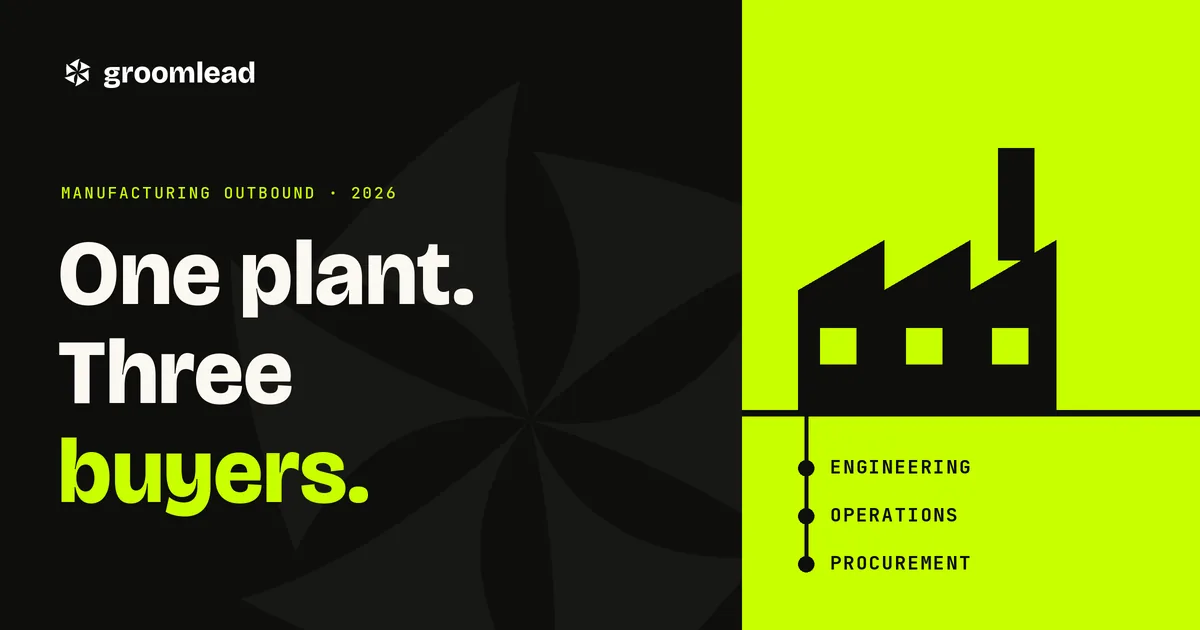
Then, for each unit, map the three functions that will touch the deal:
- Engineering validates. Process, manufacturing, quality and reliability engineers decide whether your product works in their environment. They want technical detail, compatibility and evidence.
- Operations sponsors. Plant managers, operations directors and maintenance leads own the outcome. They want to know what it changes about uptime, throughput, safety or quality.
- Procurement formalizes. Buyers and sourcing managers run approved-vendor processes, terms and pricing. They engage once someone in engineering or operations has asked them to.
This is a version of the buying committee and multithreading problem every B2B seller faces, with one twist: the three functions often sit in different buildings and report into different leaders. Building the map is the same ICP work as any market, done at the site level.
Build the list from operational data
The best manufacturing lists start from what a company makes and how it makes it, not from headcount bands.
Useful dimensions to segment on:
- Industry and product. Industry classification codes are a starting point, but product lines and processes are more precise.
- Process type. Discrete, batch or continuous manufacturing have different problems.
- Site footprint. Number and location of plants, and which ones are growing.
- Regulatory regime. Food, medical devices, aerospace and automotive each bring their own quality standards and audit pressure.
- Ownership. Private equity owned manufacturers often run operational improvement programs with clear timelines, which changes how and when they buy.
Contact data for plant-level roles is thinner than for corporate roles, and it decays as people move between sites. Running a waterfall enrichment across several providers is usually necessary to reach acceptable coverage, and our CRM enrichment work exists because most manufacturing CRMs hold the corporate address and almost nobody at the plants.
Time outreach to operational signals
Manufacturers buy when something changes in the operation. The signals worth watching:
- Plant openings, expansions and new lines. New capacity means new equipment, new processes and new suppliers.
- Hiring for specific roles. A company hiring several maintenance technicians or quality engineers at one site is telling you where the pressure is. Job descriptions often name the systems and standards in use.
- Leadership changes at site level. A new plant manager or operations director has a mandate and a short window to show results. Job-change triggers work here as well as anywhere.
- Certification and audit activity. Pursuing a new quality certification or preparing for a customer audit creates urgent, specific needs.
- Ownership events. An acquisition, often by a private equity firm, frequently triggers an operational review.
- Competitor activity. When a competitor’s sales reps start connecting with people at a plant, the plant is likely evaluating something. CAM turns that kind of buying signal, along with job changes, social listening and website activity, into lead lists.
Signal timing matters more in manufacturing than in software because the windows are real. A plant expansion has a schedule. Reaching the team after equipment and suppliers are chosen means waiting for the next one.
Write messages for each function
The same product needs three different messages.
For engineering: lead with the technical problem, in their terms. Name the process, the material, the standard or the failure mode. Offer something useful: a spec sheet, a compatibility note, a short technical call with someone who can answer hard questions. Avoid outcome claims you cannot back up. Engineers check.
For operations: lead with the operational outcome they are measured on, such as downtime, throughput, scrap, safety or labor. Be concrete about what changes on the floor and what the rollout demands of their team. Operations leaders worry about disruption as much as they want improvement.
For procurement: do not cold pitch. Reach procurement once there is internal demand, and make their job easy: supplier documentation, terms and the information their vendor process needs.
A few rules apply to all three. Keep emails short and readable on a phone. Use plain language. Reference the specific site or line when you can. And never send all three functions the same sequence on the same day, because they talk to each other, and a coordinated blast looks like spam rather than research.
Use more than email
Manufacturing outbound works best as a multichannel cadence:
- LinkedIn reaches engineers and operations leaders who are slow to answer email. LinkedIn InMails at scale let you reach people outside your network with a message that reads as personal.
- Phone still works, especially for plant-level roles and especially with a specific, researched reason for calling. Our cold calling scripts apply with more technical depth.
- Trade shows and industry events are where manufacturing relationships are often made. Outbound before and after the show, rather than only at it, is what turns a badge scan into a meeting. We covered that in our trade show lead follow-up playbook.
Run the long cycle without losing the thread
Manufacturing deals stall for reasons that have nothing to do with you: a production crunch, a budget cycle, a capital approval, an audit. A conversation that goes quiet for months and then resumes is normal, not a failure.
Three habits keep long cycles alive:
- Every reply in one place. Replies arrive on email and LinkedIn, to different senders, over months. We consolidate them into Underfive.ai, a unified inbox for every sending account with AI inbox agents that label replies, draft responses in under five minutes, and book meetings. When a plant manager replies to a thread from last spring, the full history is in front of whoever answers.
- Dated follow-ups, not vague ones. “Check back after the shutdown in March” should become a task with a date and the context attached.
- Keep threading while one function is quiet. If operations goes silent, engineering may still be evaluating. Multithreading is what keeps a deal moving while one contact is busy.
Measure what matters for manufacturing
Software metrics need adjusting for longer cycles and smaller, deeper account lists:
- Site coverage: the share of target sites where you have reached at least one engineering and one operations contact
- Meetings by function: whether you are reaching the right mix, not just the easiest titles
- Signal-to-meeting rate by trigger type: which signals are worth monitoring
- Stalled-but-alive conversations: threads with a dated next step, which are pipeline, not losses
- Time from first meeting to procurement engagement: an early indicator of whether the deal is real
Track pipeline per site rather than per company, so a deal that is lost at one plant does not hide an opportunity at another.
Where to start
Pick a single segment you know well, for example one industry and process type. Build the account map at site level, find the engineering and operations contacts at each site, and pick two or three signals to monitor. Write one message per function. Run it for a full quarter before judging it, because manufacturing replies arrive slowly.
If you want the site-level mapping, enrichment, signal monitoring and multichannel sequencing built and run as one system, talk to GroomLead. We work on a pay-per-lead model, so the engine has to produce meetings with the right buyers for it to work for either of us.
Ready to engineer your own GTM system?
GroomLead engineers outbound systems for B2B teams, and builds the tools inside this post.
Book Strategy Call