How to Build an Ideal Customer Profile for B2B Outbound That Actually Books Meetings in 2026
Most outbound that fails does not fail at the email. It fails at the list. You can write the sharpest cold message in your category, but if it lands in front of companies that will never buy, the reply rate is capped before the first send. The fix is upstream: a precise ideal customer profile that decides who is worth contacting in the first place. Here is how we build an ICP for outbound at GroomLead, and how to build one that holds up when you scale sends.
What is an ideal customer profile (ICP)?
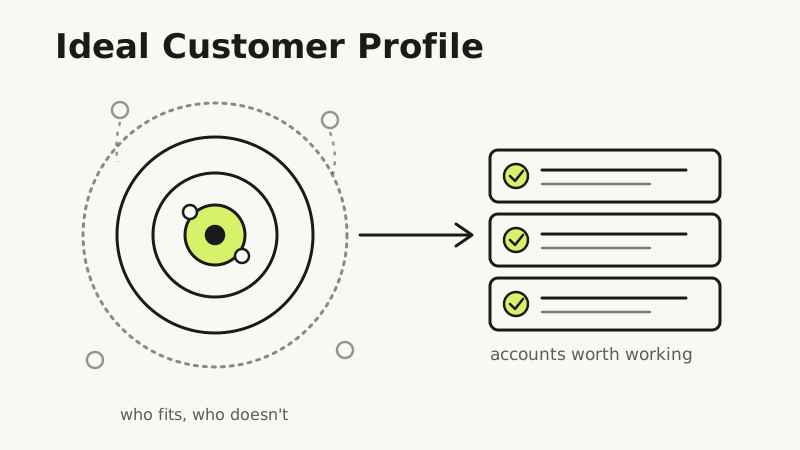
An ideal customer profile is a written definition of the type of company most likely to buy your product, stay, and refer others. It describes the account, not the person: industry, size, business model, maturity, and the specific situation that makes your product urgent right now. A good ICP is narrow enough to disqualify most of the market on sight, and concrete enough that two different reps building lists from it would target nearly the same accounts.
An ICP is not a buyer persona. The persona is the individual you email (their role, goals, and objections). The ICP is the company that individual works for. You need both, but the ICP comes first, because targeting the right person at the wrong company is still a wasted send.
Why your ICP is the highest-leverage decision in outbound
Every downstream metric inherits the quality of your ICP. Reply rate, positive reply rate, meeting-to-opportunity conversion, and eventually win rate all move together when you tighten who you contact. Three reasons the ICP outranks copy and cadence:
- It sets the ceiling on relevance. A message can only be as relevant as the account is a fit. Perfect copy to a bad-fit company is still irrelevant.
- It protects your sender reputation. Blasting off-fit lists produces low engagement and spam complaints, which quietly degrades deliverability for the good-fit accounts too.
- It compounds. A tight ICP makes personalization cheaper, qualification faster, and sales calls shorter, because the accounts already resemble your best customers.
Widening the ICP to “get more volume” is the most common self-inflicted outbound wound. More sends to worse accounts lowers the numbers that matter.
The five layers of a B2B ICP
A durable ICP stacks five layers. The first two are table stakes; the last three are where most teams under-invest and where the real precision lives.
1. Firmographics
The baseline: industry or vertical, company size (headcount and revenue), geography, and business model (B2B vs B2C, SaaS vs services). Start from your own customer base, not your ambition. Pull your best twenty accounts by retention and expansion, and find what they share. That shared shape is your starting firmographic filter.
2. Technographics
What a company uses often predicts whether they need you. A CRM, a data warehouse, a specific outbound tool, or a competitor’s product can each be a strong fit signal. Technographic filters turn “companies in SaaS” into “SaaS companies already running a sales engagement platform,” which is a far smaller and far warmer set.
3. Data quality and reachability
An account only counts if you can actually reach the right person with current contact data. This layer is invisible until you skip it, and then it shows up as bounces, wrong titles, and reps emailing someone who left a year ago. Enrich and verify before you commit an account to a sequence. Triguna returns structured, current firmographic and contact data from a company identifier or LinkedIn profile in a single API call, so the accounts entering your list are real, current, and reachable rather than a stale export you inherited.
4. Trigger fit
The strongest ICPs include a “why now.” A company can match every firmographic box and still be a bad send this quarter because nothing is forcing a decision. Trigger fit narrows the list to accounts in motion: hiring for a relevant role, opening a new office, shipping a competing feature, or changing tools. CAM monitors target and competitor company websites for the changes that signal a buying window, so your ICP is not just “companies that look right” but “companies that look right and are moving right now.”
5. Relationship fit
The warmest accounts are the ones where someone already trusts you. When a past champion, a customer who loved your product, changes jobs, their new company instantly becomes a top-tier ICP account regardless of the other filters. Champions surfaces those job changes the moment they happen, turning your existing goodwill into a fresh, pre-qualified target the week it becomes actionable.
How to write your ICP in one page
Keep the artifact short enough that the whole team actually uses it. A working ICP fits on a single page:
- Include criteria. The firmographic, technographic, and trigger filters an account must match to enter outreach.
- Exclude criteria. The explicit disqualifiers: too small, wrong region, competitor, existing customer, known bad fit.
- Tiering. Split the qualifying set into Tier 1 (perfect fit plus a live trigger), Tier 2 (strong fit), and Tier 3 (acceptable fit for volume). Tiers decide how much personalization effort each account earns.
- Evidence. One line on why each criterion is there, tied to a pattern in your actual customer data, so the ICP can be argued with and updated instead of treated as folklore.
If a criterion cannot point to evidence, it is a guess. Label it as a hypothesis and test it rather than baking it in.
Turning the ICP into booked meetings
An ICP only creates pipeline when it drives the daily list, the message, and the follow-up. Once the profile is defined, the work is execution at volume without losing the precision:
- Build the list from the ICP, every time. No random exports, no “we had extra capacity so we added a vertical.” The list is the ICP made concrete this week.
- Match effort to tier. Tier 1 accounts get researched, individually written outreach; Tier 3 gets a lighter, still-relevant touch.
- Work the whole list at a human pace. This is where hand-built outbound stalls, because researching and writing per account does not scale by headcount. VSDR deploys an AI sales development rep that researches each in-ICP account and writes individually personalized messages across the full sequence at a controlled, human-like sending pace, so a tight ICP gets worked thoroughly instead of sampled.
- Respond to interest immediately. A reply from an in-ICP account is the most valuable event in the funnel, and it cools within hours. Underfive.ai categorizes and drafts replies to inbound responses within minutes, so an engaged, on-profile prospect gets booked while the interest is still warm.
What to measure to refine your ICP
Your first ICP is a hypothesis. Instrument it so the data tightens it over time:
- Positive reply rate by segment, so you can see which industries, sizes, or triggers actually respond and prune the ones that do not.
- Meeting-to-opportunity rate by tier, to confirm your tiering reflects real buying likelihood and not just how the account looks.
- Win rate and retention by ICP cohort, the truest test, because an account that buys and stays validates the profile in a way a reply never can.
- Disqualification reasons, tracked as a list, so recurring “not a fit” patterns feed straight back into your exclude criteria.
Review the ICP quarterly against these numbers. Cut the criteria that do not predict revenue and double down on the ones that do.
A quick-start ICP checklist
- Start from your twenty best current customers, not your target market fantasy.
- Write include and exclude criteria on a single page, each backed by evidence.
- Add technographic and trigger filters so the list is warm, not just plausible.
- Enrich and verify every account before it enters a sequence.
- Tier the qualifying accounts and match personalization effort to tier.
- Work the full in-ICP list at a human cadence instead of sampling it.
- Reply to in-profile interest within minutes, not days.
- Measure positive reply, meeting-to-opp, and retention by segment, then tighten quarterly.
A strong ideal customer profile is not a slide you make once and forget. It is the filter that decides where every outbound hour goes, and it is the single highest-leverage lever you have on pipeline quality. If you would rather have that profile built, worked, and continuously refined for you than assemble it in-house, that is exactly the outbound engine GroomLead runs for its clients every day.
Ready to engineer your own GTM system?
GroomLead builds the outbound infrastructure behind 100+ agencies, and the tools inside this post.
Book Strategy Call