Customer Expansion Outbound in 2026: How to Cross-Sell and Upsell Accounts You Already Own
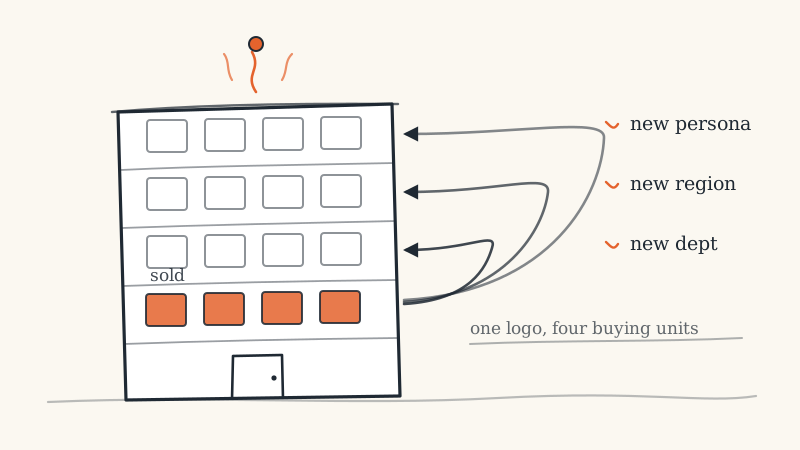
Most B2B teams run outbound against a territory of strangers while a fully qualified territory sits inside their own customer list, unworked.
The logo is signed. Somebody on the buying committee already defended you in an internal meeting. Procurement already approved you as a vendor, security already cleared you, and your invoices already clear. Then the account gets handed to customer success, who are measured on retention rather than new revenue, and the fourteen departments you never sold to are quietly treated as somebody else’s problem.
Expansion is not a renewal conversation and it is not an upsell line item in a QBR deck. A second department in an account you already serve is a genuinely new buying decision, made by people who may never have heard your name, on a budget you have no claim to. It behaves like outbound because it is outbound. The only difference is that your cold open gets to start from a reference that actually exists.
At GroomLead we build expansion as an instrumented outbound motion against the installed base, with its own account map, its own signals, and its own pipeline number. This post is that playbook.
Short answer
What is customer expansion outbound? It is a prospecting motion aimed at the unsold parts of accounts you already have: new departments, new personas, new geographies, new legal entities, and new use cases. It is run with outbound mechanics (account mapping, signal timing, sequences, reply routing) rather than left to account managers to raise ad hoc.
Why run it as outbound instead of leaving it to customer success? Because the work is prospecting work. Finding the head of a department who has never heard of you, researching their specific problem, and earning a first meeting is not the same skill as protecting a renewal. Teams that fold expansion into a CS role usually get neither: retention slips because CS is selling, and expansion stalls because nobody is prospecting.
What makes expansion outbound convert better than cold? Three things you cannot manufacture on a cold list: a reference from inside the prospect’s own company, a vendor record that has already cleared legal and security, and usage evidence that the thing you sell works in their environment. Those remove the friction that normally kills a first deal.
What is the main way it goes wrong? Assuming the warm intro is transferable. A happy user in engineering buys you exactly nothing with the VP of operations two floors up, and a message that leans on “we already work with your team” instead of on the new buyer’s own problem reads as presumptuous. The second failure mode is credit: if nobody owns expansion pipeline as a number, it does not happen.
Expansion is a different territory, not a bigger deal
The reason expansion gets neglected is structural, not strategic. Look at how a typical org assigns it:
- The AE who closed the original deal is comped on new logos and has moved on to the next one
- The CS or account manager who holds the relationship is comped on retention and is wary of anything that puts the renewal at risk
- The SDR team works a prospecting list that explicitly excludes existing customers, because “customer” is a suppression rule in the sequencer
That third bullet is the quiet killer. In most outbound stacks, the entire installed base is filtered out of prospecting by a single CRM field, and the filter is correct for the account you already sold and wrong for every department inside it you did not. Suppression should operate at the contact and buying-unit level, not the logo level.
Fixing that is a sales ops decision before it is a messaging decision. Until the data model can tell the difference between “this company is a customer” and “this specific buying unit is sold”, you cannot run the motion safely, because your first expansion campaign will email the champion who is mid-renewal with a cold pitch for the thing she already bought.
The four expansion plays
Expansion is not one motion. Separate it into four, because each has a different buyer, a different message, and a different signal.
1. New department, same product
The clearest play. Marketing bought your product, and sales, support, and operations have the same problem. The buyer is new, the use case is adjacent, and your internal reference is strong because it is literally the team down the hall.
Qualifying question: does the second department have its own budget and its own evaluation process? If yes, it is a net-new deal and should be worked as one. If it is just more seats on the first department’s contract, it is an upsell for the account manager, not an outbound play.
2. New persona, same department, bigger mandate
You sold a manager, and the director or VP above them has a budget line, a wider problem, and no idea you exist. This is the play that turns a small departmental tool into a platform decision, and it is the one teams most often fumble by routing it through the original champion. Champions protect their standing: asking yours to introduce you to their boss can read as going over their head.
Run it as multithreading instead. Reach the senior persona directly with a message about their problem at their altitude, and let the existing deployment be evidence rather than the ask.
3. New geography or legal entity
The enterprise play. A global parent signed in one region, and EMEA, APAC, and the acquired subsidiary all procure independently. Finding these requires actual corporate structure work: parent and child relationships in the CRM, domain variants, and local entity names that often do not match the parent brand.
This play has the longest cycle and the highest ceiling, and it fails most often because nobody ever built the account hierarchy. Two accounts that look unrelated in your CRM are frequently the same company.
4. New product, same buyer
The cross-sell proper. You have a second thing to sell, and the person who bought the first thing is the right buyer for it. Easiest to execute, and the one with the worst reputation, because it is usually run as a mass email to the entire customer base the week the new product ships. Do it on a signal instead of a launch date.
Build the expansion account map
Cold outbound starts with an ICP and builds a list. Expansion outbound starts with a list you already own and builds a map. The unit of work is the account, and the deliverable is a grid.
For each customer account, record:
| Dimension | What to capture |
|---|---|
| Sold units | Which departments, entities, and regions are under contract today |
| Adjacent units | Which exist in the org and have the same problem |
| Headcount per unit | Enough to know if the unit can carry a deal |
| Named contacts | Who you know, their role, and whether they are a champion or a user |
| Blank space | Units with no contact in your CRM at all |
| Health | Is the existing deployment working, and is the renewal safe |
That last row is the gate. Expanding into an account whose current deployment is struggling converts badly and endangers the revenue you already have. Health status, not enthusiasm, decides which accounts are eligible this quarter.
The blank-space row is where the actual prospecting lives. For a 200-person customer with one 12-person team under contract, you are looking at a 188-person account you have never sold into, and your CRM probably holds four contacts for it. Enriching that structure is the same waterfall enrichment problem as any cold list, with one advantage: you can verify your inferences against people who already take your calls.
Time the ask to a signal, not to a quarter
The default expansion trigger is the calendar: new quarter, new cross-sell push. That is why customers brace for it. Signal timing is what separates an expansion motion that feels like service from one that feels like farming.
The signals worth monitoring inside the installed base:
- A new leader lands in an unsold department. New executives rebuild their stack in the first months, and they arrive with a mandate to change something. A new VP of ops in an account where marketing already uses you is the single best expansion trigger there is.
- Your champion gets promoted or takes a wider remit. The relationship is intact and the budget just got bigger.
- The unsold department starts hiring. Open roles describe the problem in the department’s own words, and a team scaling headcount is a team whose process is breaking.
- The account acquires a company or opens a region. New entity, new procurement, unsold by definition.
- Website activity from unfamiliar parts of a customer account. Someone from a department you do not serve reading your product pages is doing unprompted research.
- Competitor footprint in the unsold unit. The department you want is evaluating or already running somebody else, which turns the play into competitive displacement with a reference advantage.
Monitoring those by hand across a few hundred customer accounts is not realistic, which is why we wire the installed base into the same signal layer as the cold territory. CAM handles the buying-signal side: job changes, social listening, competitor connections, and website activity, turned into lead lists. Pointed at the customer base rather than a prospect list, it surfaces the new ops VP and the hiring spike in the unsold division as they happen, instead of in next quarter’s account review.
The job-change signal deserves particular attention here, and it cuts both ways. When your champion leaves for a new company, that is champion tracking and a new-logo play. When somebody lands inside an account you already serve, that is expansion. Same monitoring, two different pipelines, and most teams only built the first one.
The message: warm reference, cold respect
The hardest part of expansion outbound is tone. You have a real asset (an existing relationship in the building) and the temptation is to lead with it. Leading with it makes the email about you.
The structure that works puts the new buyer’s problem first and the reference second, as evidence:
- Open on their situation, not your contract. Something specific and current about their department: the hiring they are doing, the region they just opened, the mandate the new leader was given.
- State the problem in their language. Not the problem your first champion had. The problem their function has, which is often materially different even with the same product.
- Use the internal deployment as proof, once, plainly. “Your marketing team has been running this since March” is a fact that does useful work. “As you may know, we are already a trusted partner of your organization” is a claim that does none.
- Ask for a first meeting, not a referral. You are not asking them to validate a relationship they were not part of.
- Give them a way to check you out internally. Naming the team that already uses you lets them verify without talking to you, which is a feature. A buyer who asks a colleague about you and gets a good answer arrives to the first call pre-sold.
What to never do: CC the existing champion, imply the other department endorsed the expansion, or send anything that reads as though the decision has already been made upstairs. Expansion email that smells like internal politics gets forwarded, and not kindly.
For the new-product cross-sell to an existing buyer, the same rules apply with one addition: acknowledge what they already have and be explicit about what is different. A buyer who thinks you are pitching them the thing they already own stops reading.
Route the replies faster than a cold campaign
Expansion replies carry higher stakes than cold replies, because a mishandled one damages revenue you are already booking. They also arrive in more places: the sequencer, the AE’s inbox, the account manager’s inbox, and sometimes forwarded from the original champion asking what this is about.
Two operational requirements follow:
Everything lands in one place. A reply from a customer account that sits unread in a mailbox nobody checks is the expansion equivalent of a dropped inbound lead. We consolidate sending accounts into Underfive.ai, a unified inbox for every sending account with AI inbox agents that label replies, draft responses in under five minutes, and book meetings. For expansion, the labeling matters as much as the speed: a reply that is actually a support complaint, or the champion asking whether this is sanctioned, has to be recognized and routed to a human immediately rather than answered with a booking link.
The account team knows before the prospect tells them. Any reply from a customer domain should notify whoever owns that account the same day. Not for permission (asking account managers to approve every expansion touch is how the motion dies) but so that nobody is blindsided on a renewal call. The speed-to-lead discipline applies, with an extra internal hop.
Measure it as its own pipeline
Expansion revenue that gets reported inside net revenue retention is invisible, and invisible motions do not get funded. Pull it out:
- Expansion pipeline created, counted only from net-new buying units, never from seat adds or renewals
- Account penetration, the share of identified buying units inside a customer that are sold, which is the real ceiling on this motion
- Blank-space coverage, how many unsold units you have actually contacted this quarter, the honest activity metric
- Signal-to-meeting rate per trigger type, which tells you which signals to keep paying for
- Cycle length versus new logo, your evidence that the motion is cheaper, and the number to watch if expansion deals start taking as long as cold ones
- Renewal health of accounts in an active expansion play, the guardrail that proves you are not trading retention for cross-sell
The arithmetic is worth doing explicitly before you staff it. Take 150 customer accounts averaging three unsold buying units each. That is a 450-unit territory, which is a real quarter of prospecting for one person, against a list where every single account already pays you. Whether that beats 450 cold accounts depends on your product, but it is the comparison nobody runs, because the 450 units were never on a list in the first place.
Failure modes to design around
No owner. Shared responsibility between AE and CS means nobody prospects. Give expansion a name and a number, whether that is a dedicated rep, the SDR team with the suppression rule fixed, or an AE with a quota split.
Blind suppression. Either you email every customer contact indiscriminately, or you suppress the whole logo. Both are data model failures. Suppress at the buying-unit level.
Expanding into unhealthy accounts. Check deployment health first, every time.
Treating the champion as a channel. Your champion is a reference, not a lead-gen function. Over-asking for introductions spends relationship capital you will want at renewal.
Launch-date cross-sell blasts. The new product shipped, so everyone gets an email. This is the behavior that taught customers to distrust expansion outreach.
Stale org maps. Expansion maps go out of date as fast as any contact list. People move, departments reorganize, entities get absorbed. The same data decay that rots a cold list rots your account map, and here it is worse, because a wrong assumption about a customer’s org chart shows up in front of someone who already knows you.
Where to start
Pick your twenty largest healthy customers. For each one, write down the buying units you have sold and the buying units you have not, and count the contacts you hold in the unsold ones. Most teams discover two things in that exercise: the unsold territory is several times larger than they assumed, and their CRM is nearly empty on it.
That gap is the work. Enrich the blank space, wire the customer base into the same signal monitoring as your cold territory, route expansion replies into one inbox with a human on standby for the sensitive ones, and report the pipeline separately so it survives the next planning cycle.
If you want the expansion map built, the signals monitored, and the sequences run as one system rather than a side project nobody owns, talk to GroomLead. We engineer outbound against the installed base the same way we engineer it against a cold territory, which is the whole point: it is a territory.
Ready to engineer your own GTM system?
GroomLead engineers outbound systems for B2B teams, and builds the tools inside this post.
Book Strategy Call