Competitor Displacement in 2026: How to Win B2B Deals Away From Incumbents With Timed Outbound
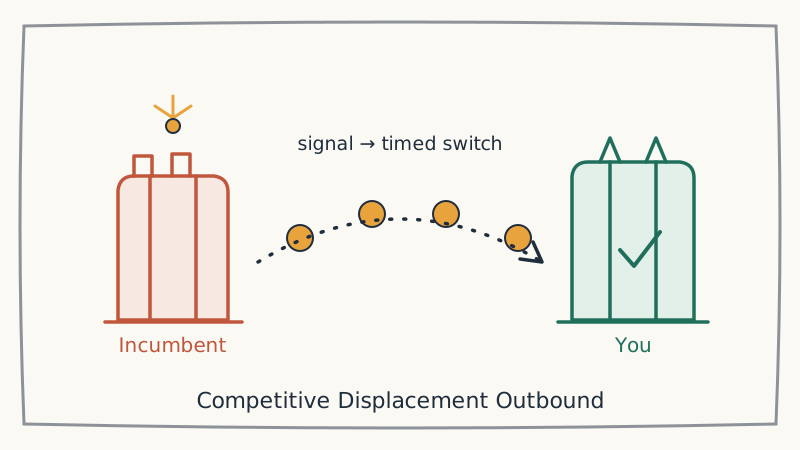
Displacing a competitor is the hardest and most valuable move in outbound. The prospect already has a tool that does roughly what you do, a budget line already spent, and a status-quo bias that makes “do nothing” the default answer. Cold volume does not crack that. What cracks it is timing: reaching the right account in the narrow window when the incumbent has just failed them, when a contract is about to renew, or when the person who championed the old tool has left. This guide lays out a competitor displacement playbook built for 2026, where the accounts, the timing, and the follow-up are all driven by signals rather than guesswork, and where GroomLead runs the whole motion as one instrumented system instead of a hopeful blast.
What is competitor displacement in B2B sales?
Competitor displacement is the outbound motion of winning customers who already use a rival product, by convincing them to switch to yours. It is distinct from selling to a greenfield prospect who has no solution yet. In a displacement deal the buyer has already been educated on the category, so you are not selling the problem; you are selling the switch. That changes everything about the message, the timing, and the proof you need to bring.
The core difficulty is that switching has a cost the prospect feels and a benefit they only imagine. Migration effort, retraining, and the risk of a worse outcome are all concrete and immediate. Your improvement is a promise about the future. A displacement play wins when it shrinks the perceived switching cost and lands at a moment when the pain of staying finally outweighs the pain of moving.
Why most displacement outreach fails
Most teams run displacement like ordinary cold outbound: a big list of accounts that might use a competitor, a generic “we do it better” message, and a spray across all of them at once. It fails for three predictable reasons.
- It is untimed. A perfect switch message sent six months before renewal lands on someone with no reason to act. The same message sent two weeks after an outage gets a reply.
- It is unqualified. “Might use the competitor” is not the same as “uses the competitor and is unhappy.” Blasting the whole category wastes the motion on happy, locked-in customers.
- It attacks instead of reframing. Trashing the incumbent insults the buyer who chose it. The buyer hears “you made a dumb decision,” and defends the status quo harder.
Fixing all three means treating displacement as a signal problem first and a messaging problem second. You find the accounts that actually use the competitor, wait for the moment their patience or their contract runs out, and then reach out with a message that respects the original choice while making the switch feel safe.
How do you find accounts that use a competitor?
You cannot displace a competitor you cannot see. The first job is building a list of accounts that actually run the incumbent, not accounts that vaguely resemble their customers. There are four reliable sources of that signal, in rough order of confidence.
- Technographic footprint. Many tools leave detectable traces: a tracking script, a subdomain, a support widget, a job posting that names the product. Enriching each target account with current technographic data tells you who is running the incumbent right now.
- Public customer signals. Case studies, review-site profiles, integration directories, and social mentions all name customers openly. A competitor’s own logo wall is a displacement list.
- Champion movement. Someone who used your product at a past company and just landed at an account running the incumbent is the warmest displacement lead in existence.
- Self-reported friction. Prospects who publicly complain about the incumbent (on review sites, in communities, on social) are pre-qualified by their own words.
The data-quality trap here is the same one that sinks all outbound: a list that was accurate last quarter is wrong today. Companies switch tools, contacts change roles, and stale technographics send you chasing accounts that already left the incumbent. Verifying the footprint at the moment of outreach is what keeps the list real. Triguna returns current firmographic and technographic data from a domain or profile, so the account you are about to work still runs the competitor today rather than in a snapshot from six months ago.
Timing is the whole game: the displacement trigger windows
A displacement message is only as good as the moment it lands. The same words are noise on a random Tuesday and a lifeline the week after the incumbent breaks. These are the windows worth waiting for.
| Trigger | Why it opens a window | How you catch it |
|---|---|---|
| Renewal approaching | Budget and switching decision are both live | Contract timing, fiscal-year patterns, hiring signals |
| Incumbent outage or incident | Trust in the current tool just cracked | Monitoring the competitor’s status and social sentiment |
| Pricing or packaging change | A price hike reopens the buy decision | Watching the competitor’s pricing page and announcements |
| Champion of the old tool leaves | The internal defender of the status quo is gone | Job-change tracking on the account |
| Public complaint or bad review | The buyer has declared their own pain | Review-site and social monitoring |
The thread through every row is that these are events, not steady states, and they decay fast. A price hike is a hot topic for a week and old news in a month. Catching them requires watching the competitor continuously rather than checking in when you happen to remember. CAM monitors target and competitor sites for exactly these changes (pricing edits, outages, messaging shifts, and other buying-window markers) and delivers each one as a dated trigger, so a displacement play enters the sequence as a timed event instead of something a rep has to stumble onto.
The warmest displacement play: follow your champions
Every displacement window in the table above is external. There is one more that is internal to your own history and converts better than all of them: a person who already loved your product, now working at a company that runs your competitor.
They need no education on your value, they carry no loyalty to the incumbent they inherited, and they often arrive with a mandate to change things in their first ninety days. The only hard part is knowing the week they move, because that window closes as they settle into the new stack. Champions surfaces when a past user or advocate changes jobs, turning a former customer in a new seat into a pre-warmed displacement lead the moment they land, while the incumbent tool they inherited is still up for review.
How to write a competitor displacement message
Once the account and the timing are right, the message has one job: make switching feel safe and make staying feel expensive. A few rules separate a switch email that converts from one that hardens the status quo.
- Never attack the incumbent. The buyer chose it. Respect the choice and reframe around what changed: “When you picked them, X was not a problem yet. It is now.”
- Anchor on the trigger. Reference the specific event that opened the window (the price change, the outage, the renewal) so the timing feels like a reason, not a coincidence.
- Shrink the switching cost out loud. Name the migration path, the timeline, and who does the work. Uncertainty about effort is the number one reason a displacement stalls.
- Bring switch-specific proof. A generic case study is weak. “Three teams that moved off [the exact incumbent] last quarter” is a mirror the buyer sees themselves in.
- Lower the ask. The goal is a fifteen-minute look, not a rip-and-replace decision. A small next step beats a big one every time.
Writing this well for one account is easy. Writing it well for two hundred, each referencing a different trigger and a different incumbent pain, is where most teams collapse back into a generic template. Personalization that survives scale is a capacity problem, and VSDR deploys an AI sales development rep that researches each account and tailors the switch message across a full multi-channel sequence at a human sending pace, so account two hundred reads as sharply as account one.
What happens when they reply?
A displacement reply is fragile in a way a cold reply is not. The prospect is weighing a switch, and their interest is bounded by the window that opened it. A “tell me more” that sits in an inbox for a day cools into “we decided to stay.” Speed of response is not a nicety here; it is the difference between a booked evaluation and a lost one.
The reply also tends to arrive loaded with switch-specific questions: what does migration look like, can you import our data, how long until we are live. Answering those fast and accurately, while the trigger is still fresh, keeps the deal warm. Underfive.ai categorizes and drafts responses to inbound replies within minutes, so a displacement prospect’s questions get answered while their patience with the incumbent is still thin, not after they have talked themselves back into staying.
How do you measure a displacement motion?
Displacement deals behave differently from greenfield deals, so a blended pipeline dashboard hides what is working. Track the motion on its own terms.
- Coverage of the incumbent base. What share of known competitor accounts are you actually working? Low coverage means a data problem, not a messaging one.
- Trigger-to-touch latency. How fast does an outreach fire after a displacement signal appears? Every day of lag shrinks the window.
- Reply rate on triggered vs untriggered sends. If timed sends do not beat cold sends by a wide margin, your triggers are weak or stale.
- Switch-intent reply rate. Replies that engage with the switch (asking about migration, timeline, pricing) rather than a flat no.
- Win rate against the specific incumbent. Segment by competitor. You will beat some rivals far more often than others, and that tells you where to aim.
Each of these ratios maps to a layer of the system, which means a soft number points to a specific fix: weak coverage points at data, high latency points at monitoring, a low triggered reply rate points at timing or copy. That diagnostic clarity only exists when the layers are instrumented together instead of run as disconnected tools.
The competitor displacement checklist
- Build the list from real technographic and public signals, not lookalike guesses.
- Verify the incumbent footprint at the moment of outreach so you never chase accounts that already left.
- Wait for a trigger window: renewal, outage, price change, champion exit, or public complaint.
- Prioritize your own returning champions who land at competitor accounts.
- Reframe the switch, never attack the buyer’s original choice.
- Anchor every message on the specific trigger that opened the window.
- Shrink the perceived switching cost by naming the migration path out loud.
- Answer replies within minutes, while the incumbent pain is still fresh.
- Measure coverage, latency, and win rate per competitor, not as a blended number.
Displacement is not a volume game and it is not a trash-talk game. It is a timing game, won by the team that sees the window first and moves through it fastest. That requires the account data, the competitor signals, the champion intelligence, the personalized sequencing, and the fast reply handling to all run as one connected system. If you would rather have that system built, instrumented, and operated for you, that is exactly the motion GroomLead runs for its clients: finding the accounts stuck with an incumbent, timing the switch to the moment it can happen, and measuring every displacement win back to the signal that opened the door.
Ready to engineer your own GTM system?
GroomLead builds the outbound infrastructure behind 100+ agencies, and the tools inside this post.
Book Strategy Call