Cold Email Personalization at Scale: How to Make Every Outbound Message Feel 1:1 in 2026
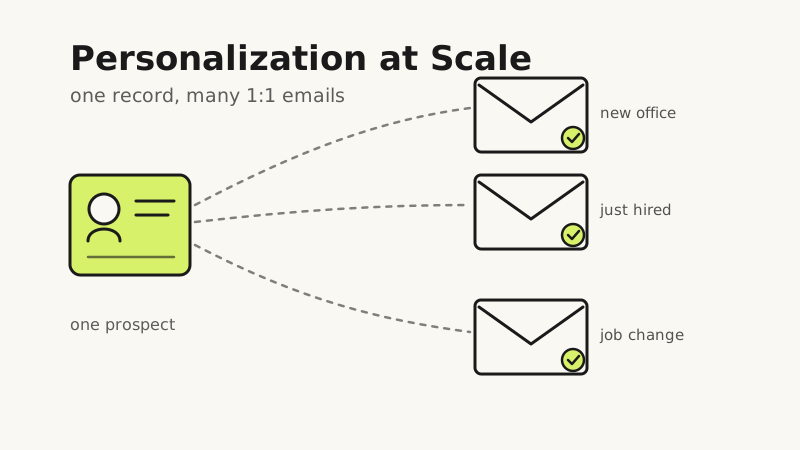
Every rep knows personalized cold email works better. The problem was never the belief, it was the math. Researching a prospect and writing a message built around one real detail takes fifteen minutes, and fifteen minutes times four hundred prospects is a week you do not have. So teams quietly gave up: they blasted a generic template, watched reply rates sag, and told themselves cold email was dead. It is not dead. It just stopped scaling by hand. Here is how we personalize outbound at scale at GroomLead, and how you can build the same system.
What does “cold email personalization at scale” actually mean?
Personalization at scale means every prospect receives a message shaped by something specific and true about them, produced by a repeatable system rather than by a rep writing each one from a blank page. It sits between two failed extremes. On one end is the mail merge, where the only variable is a first name and the body is identical for everyone. On the other is fully hand-written outreach, which reads beautifully and reaches almost nobody because it does not scale past a few dozen sends a day.
The middle path is a system that treats personalization as data plus assembly: pull real facts about each prospect, decide which fact matters for this message, and generate copy around it automatically. Done right, the recipient cannot tell whether a person or a system wrote it, and you can send hundreds a day instead of dozens.
Why generic templates stopped working
Buyers in 2026 have seen thousands of cold emails, and they pattern-match instantly. A “{{first_name}}, I came across {{company}}” opener is now a recognized signal for “this was sent to ten thousand people,” and it gets deleted before the second line. Three forces make generic outreach worse every year:
- Volume immunity. The average buyer’s inbox is full of templated pitches, so anything that looks templated is filtered by the human before the filter even matters.
- Deliverability penalties. Identical bulk copy is one of the patterns spam systems score against, so generic sends also land in fewer inboxes to begin with.
- Rising expectations. When some of your competitors send genuinely relevant outreach, an irrelevant blast does not just underperform, it makes your brand look careless by comparison.
Personalization is no longer an edge. It is the entry fee for getting read at all.
The three layers of personalization that scale
Not all personalization is equal, and the best-performing outreach stacks three distinct layers. Each one is harder to fake than the last, and each one can be produced by a system rather than by hand.
1. Firmographic and role relevance
The baseline layer is being obviously correct about who the prospect is: their actual role, the size and industry of their company, the tools they likely use, the problems that role owns. This is the layer most teams get wrong because their list data is stale, so they address a director who was promoted a year ago or pitch a use case that does not apply.
Getting this layer right starts with clean, current data. Before a single message is written, verify and enrich each record so the facts you personalize around are real. Triguna returns structured, current firmographic and contact data from a LinkedIn profile or company identifier in one API call, so the role, seniority, and company details feeding your copy are accurate at send time rather than whatever the list claimed six months ago.
2. Trigger and timing relevance
The second layer is reaching out because of something happening now. A message that references a real, recent event (“I saw you just opened a second office,” “noticed you are hiring three SDRs”) outperforms a timeless pitch because it proves you are paying attention and it arrives when the need is fresh.
The trick is detecting those triggers automatically instead of manually stalking hundreds of accounts. CAM watches competitor and target company websites for the changes that signal a buying window, so you can open with a specific, timely observation the week a prospect is actually in motion. And the warmest trigger of all is a past champion changing jobs, because they already trust you; Champions surfaces those moves the moment a former buyer lands somewhere new, turning a job-change alert into a personalized opener that practically writes itself.
3. Individual insight
The top layer is the detail that could only apply to this one person: something they posted, a specific line on their site, a point of view they published. This is the layer that historically did not scale, because finding that detail meant a human reading a profile. In 2026, that research step is automatable, which is what makes real 1:1 outreach possible at volume for the first time.
The workflow that makes it scale
Put the layers together and personalization at scale becomes an assembly line, not an art project. The workflow has four stages:
- Source a targeted list tied to a real reason to reach out, not a random export.
- Enrich and verify every record so the facts are current and the person still holds the role.
- Research and write a message per prospect that stacks the three layers above.
- Send and respond at a human cadence, then handle replies fast.
Stage three is where hand-work used to break the system, and it is exactly the stage AI now closes. VSDR deploys an AI sales development rep that researches each prospect and writes individually personalized messages across the whole sequence at a controlled, human-like sending pace, so every email is built around that specific buyer without a rep spending fifteen minutes per message. That is the unlock: the quality of hand-written outreach at the volume of automated outreach, instead of trading one for the other.
Personalization does not end at send
A personalized email earns a reply, and the moment it does, the personalization has to continue. A prospect who answers a tailored message and then gets a slow, generic follow-up feels the bait-and-switch immediately. Speed matters too, because an engaged thread cools within hours and fast, relevant replies are also a positive signal to mailbox providers. Underfive.ai categorizes and drafts responses to inbound replies within minutes, so the interest your personalized opener created turns into a booked meeting while it is still warm rather than decaying in an unread inbox.
What to measure
Personalization is worth the effort only if it moves the numbers, so instrument it:
- Reply rate by personalization layer, so you learn whether firmographic, trigger, or individual detail is actually driving responses for your audience.
- Positive reply rate, not just any reply, because relevance should lift genuine interest, not just polite declines.
- Meetings booked per hundred sent, the number that ties personalization to pipeline.
- Time per personalized message, because the entire point of the system is driving that toward zero without hurting the metrics above.
If a personalization layer does not lift reply quality, cut it and reinvest the effort in the one that does.
A quick-start checklist
- Kill the generic template; assume anything that looks merged gets deleted unread.
- Build personalization in three layers: role relevance, timing triggers, and individual insight.
- Verify and enrich every record before writing, so you personalize around real facts.
- Trigger outreach off real events instead of sending at random.
- Automate the research-and-write step so 1:1 quality reaches automated-outreach volume.
- Keep replies personal and fast, within minutes, not days.
- Measure reply quality by layer and cut what does not earn its place.
Cold email personalization at scale is not a copywriting trick, it is a data-and-assembly system: accurate inputs, real-time triggers, automated research, and fast human-quality follow-up. The teams winning outbound in 2026 are the ones who stopped choosing between relevant and scalable and built the pipeline that delivers both. If you would rather have that system built, triggered, and run for you than assemble it in-house, that is exactly the kind of outbound engine GroomLead runs for its clients every day.
Ready to engineer your own GTM system?
GroomLead builds the outbound infrastructure behind 100+ agencies, and the tools inside this post.
Book Strategy Call