Closed-Lost Reactivation in 2026: How to Win Back Lost B2B Deals With Signal-Timed Outbound
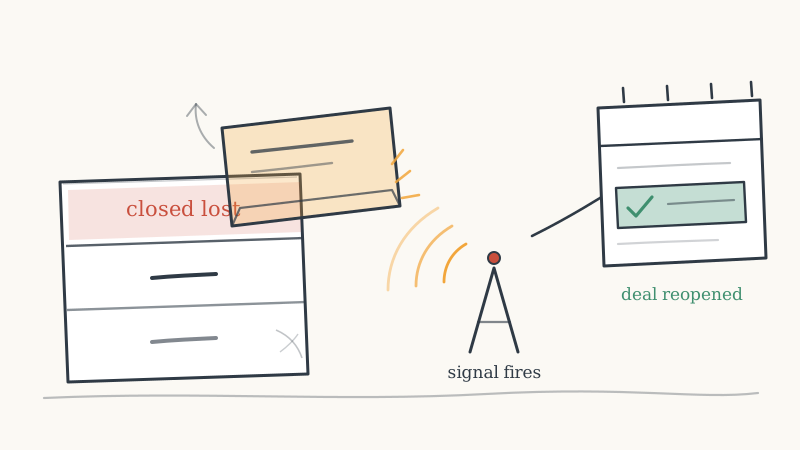
The cheapest qualified pipeline most B2B teams have is sitting in a CRM stage nobody opens.
Closed-lost is the largest segment in almost every pipeline. A team that runs 400 opportunities a year and closes 80 of them is carrying 320 accounts that went through discovery, sat through a demo, saw pricing, and had a reason to buy. They are already qualified. They already know your name. The only thing wrong with them is that at one specific moment, the answer was no.
Then everyone treats that no as permanent, which it almost never was. Most lost deals were not lost on the product. They were lost on budget cycle, on a competing priority, on an incumbent contract with eleven months left, or on a champion who did not have the internal weight to push it through. All four of those things expire. Nobody is watching for the expiry.
At GroomLead we treat closed-lost as a signal-monitored segment rather than an archive, and this post is the playbook.
Short answer
What is closed-lost reactivation? It is a deliberate outbound motion that re-approaches previously lost opportunities when something has changed that invalidates the original reason for the loss. It is not a quarterly “just checking in” blast to every lost deal in the database.
Why does it work better than cold outbound? Because the expensive parts are already done. The account is qualified against your ICP, the problem has been articulated out loud, your product is a known quantity, and in many cases you have a named contact who liked you. Reply rates on a well-timed win-back commonly run several times a cold list, and the sales cycle is shorter because discovery does not restart from zero.
What makes the difference between a win-back that works and one that annoys people? Timing tied to a real event, and a message that acknowledges the previous loss honestly. The two failure modes are blasting the whole lost-deal list on a calendar schedule, and pretending the earlier no never happened.
How much pipeline should you expect? A disciplined program typically re-opens 5% to 15% of a mature closed-lost pool per year. On a 320-deal pool that is 16 to 48 reopened opportunities at close to zero acquisition cost.
Why “closed-lost” is a worse label than the data deserves
The stage name does the damage. Marking an opportunity closed-lost is operationally identical to marking it closed-won in one respect: both remove it from the working set. One of those removals is correct.
Here is what that same record actually contains:
- A company that passed your qualification bar well enough to get an opportunity created
- A documented problem, usually in the notes of a discovery call
- A known evaluation process and, often, a known competitor
- At least one human who took multiple meetings with you
- A specific, dated reason the deal did not happen
That last field is the whole asset, and it is the one most teams fill in worst. “Lost to competitor” and “no budget” are the two most common entries in B2B CRMs and neither one is actionable. “Lost to Competitor X, 24-month contract signed Feb 2025, champion said they would revisit if pricing moved” is actionable, because it tells you the month to come back and what to lead with.
If your loss reasons are a free-text field with 40 unique values in it, the reactivation program cannot be built yet. Fix that first. It is a 30-minute picklist change and it is the difference between a program and a guess.
Step 1: segment the lost pool by loss reason, not by date
The instinct is to sort closed-lost by age and work the oldest first. That is the wrong axis. A deal lost 18 months ago on a budget freeze is far more workable than one lost last quarter because your product genuinely could not do the thing they needed.
Sort by whether the loss reason has an expiry date.
| Loss reason | Expires? | What to wait for |
|---|---|---|
| No budget this cycle | Yes, predictably | New fiscal year, funding round, headcount growth |
| Lost to a competitor | Yes, on contract term | Renewal window, competitor outage or price change, visible dissatisfaction |
| Not a priority right now | Yes, on leadership change | New exec in the function, a strategic initiative that makes it a priority |
| No champion, no internal push | Yes, on personnel | Champion gets promoted, or a new leader arrives with a mandate |
| Chose to build in-house | Usually yes, 12 to 24 months | The internal project stalls, the engineer who built it leaves |
| Missing a specific feature | Only if you shipped it | Your own roadmap, not their calendar |
| Price was structurally too high | Sometimes | They raise a round, grow, or you launch a lower tier |
| Not actually in your ICP | No | Nothing. Suppress permanently. |
| Hostile or abusive process | No | Nothing. Suppress permanently. |
Two of those nine rows should be removed from the program entirely. Teams that skip that step end up with a reactivation list that is 30% accounts who were never going to buy, which drags every metric down and makes the whole motion look like it does not work.
The rest get a watch condition. That is the point of the exercise: you are converting a static archive into a set of named triggers.
Step 2: refresh the contact data before you touch anything
A closed-lost record is, by definition, old data. Between 20% and 30% of B2B contacts change role or employer in a year, so a two-year-old lost deal has a good chance that your main contact is no longer there, and a near certainty that at least one person on the buying committee has moved.
This matters more for win-backs than for cold outbound, because the entire premise of your message is a shared history. Emailing a bounced address wastes the attempt. Worse, emailing a replacement who inherited the mailbox with a note referencing a conversation they never had is a conversation you cannot recover from.
So before any reactivation sequence is loaded, the segment gets re-enriched: current title, current employer, verified email, and the current shape of the account. This is the same hygiene problem we covered in why your CRM rots, just concentrated into the oldest and least-maintained part of the database.
The contact churn is not only a cleanup cost. It is frequently the trigger itself, which is the next step.
Step 3: wait for the signal that changes the answer
This is the part that separates a program from a blast. Every row in the table above has a watch condition, and the job is to be monitoring for it rather than guessing at it on a quarterly cadence.
The signals that most reliably reopen a lost deal:
Your champion changed jobs. The best win-back signal in B2B, and it works in both directions. If the person who wanted to buy you has moved to a new company, they can often buy you there with no evaluation at all, because they already did it. And if they have been promoted internally, the budget authority that was missing last time may now exist. The mechanics of monitoring and acting on this are in the job change triggers playbook.
A new leader arrived in the function. New VPs audit the stack in their first 90 days and are structurally more open to replacing an incumbent than the person who selected it. A deal lost on “not a priority” becomes live the week someone new owns the priority list.
The competitor’s contract window opened. If you logged the signing month, you know roughly when the renewal conversation happens inside that account, and the useful time to be in the inbox is 60 to 90 days before it, not after. The full motion is in the competitor displacement playbook.
The account is showing fresh research behavior. Someone from a company you lost 14 months ago reading your pricing page is one of the highest-intent events in your entire funnel, and most teams never see it because the account is not in an active sequence.
The account grew, raised, or restructured. A funding round, a new office, a hiring spike in the team that would use your product, or an acquisition all change the budget math that killed the deal.
This is monitoring work, not research work, and the distinction matters because the volume makes manual checking impossible. Watching 320 accounts for five signal types is 1,600 standing checks. CAM exists for exactly this shape of problem: it tracks buying signals including job changes, social listening, competitor connections and website activity, and turns them into lead lists, which is what a reactivation queue actually is. Point it at the closed-lost segment and the archive starts producing a weekly working list instead of a quarterly guilt trip.
The broader framework for scoring signals against each other, when several fire at once, is in our buyer intent signals playbook.
Step 4: write the re-approach
A win-back email is a different genre from a cold email, and borrowing cold email structure is the most common writing mistake here. Cold email has to establish relevance from nothing. A win-back has to do something harder: acknowledge a prior outcome without being awkward about it, and give a concrete reason why now is different.
Four rules.
Name the previous conversation plainly. Not “I wanted to circle back” and not an unexplained new pitch to someone who already evaluated you. “We spoke in March 2025 about your deliverability problem and you went with Competitor X” is a stronger opening line than anything a subject line generator will produce, because it is specific, true, and verifiable in two seconds.
Lead with what changed, and make it their change where possible. The weakest version is “we have shipped a lot since then.” The strongest is tied to the signal that triggered the send: the new VP, the renewal window, the funding round, the promotion. Your own product changes are only interesting when the deal was lost on a specific missing feature, in which case say exactly which one and that it now exists.
Concede the earlier decision without relitigating it. “You picked the right option for where you were” costs you nothing and removes the defensiveness that kills most win-back threads. Do not argue about the original bake-off. The person who made that call may still be the one reading.
Ask for something smaller than a demo. They have already seen the demo. Ask whether the original problem is still a problem, or offer a 15-minute update on the one thing that changed. A re-opened deal rarely restarts at the top of the funnel, so your ask should not either.
A workable shape, roughly 90 words:
Subject: the deliverability thing, 18 months later
Hi Dana, we talked in March last year about inbox placement across your 6 sending domains, and you went with Competitor X. Reasonable call at the time.
I saw Priya joined as VP Revenue Ops last month. Two things are different on our side since you looked: domain-level warmup is now automated, and reply routing happens in one inbox instead of six.
Worth 15 minutes to see if the original problem is still a problem? Happy to skip the demo and just show you the part that changed.
Note what is absent: no “just checking in,” no pretending the loss did not happen, no re-pitch of the full product. One acknowledgement, one specific change, one small ask.
Step 5: be there when they reply
Win-back replies are disproportionately high value and disproportionately easy to lose, for a structural reason: they do not arrive in anyone’s active queue. The account is closed in the CRM, the original rep may have left, and the reply lands in whatever mailbox the reactivation sequence sent from.
The pattern is predictable and expensive. A buying-committee member answers “actually yes, we are revisiting this in Q3,” nobody triages it for four days, and an account that took 18 months to become workable again goes quiet. The response-time economics are identical to the ones in the speed-to-lead playbook, except the lead took a year and a half to regenerate.
Two things have to be true before the first send. Replies from every sending account have to land somewhere a human is actually watching, and a positive reply has to get answered in minutes rather than days. Underfive.ai covers that layer: one unified inbox across every sending account, with AI inbox agents that label replies, draft responses in under 5 minutes, and book meetings. For a reactivation program specifically, the labeling matters as much as the speed, because a lost-deal list produces a wider spread of reply types (the contact who left, the replacement who has no context, the person who is still under contract and wants to be contacted in nine months) and each needs a different next step.
The reply taxonomy and routing rules are covered in more depth in our reply management playbook.
Step 6: sequence length and re-entry rules
A reactivation sequence should be shorter than a cold sequence. Three to four touches over two to three weeks, not eleven over six.
The reason is that the premise is already established. If a known contact at a qualified account does not respond to a specific, well-timed, honest re-approach in four touches, the answer is almost always timing rather than attention. Touch nine does not fix timing. It just converts a recoverable relationship into an unsubscribe.
Set these rules explicitly:
One reactivation attempt per signal, not per quarter. The trigger, not the calendar, decides when an account re-enters. An account with no new signal does not get touched again.
Minimum 6 months between reactivation attempts on the same account. Even when two signals fire, the second contact waits. Nothing in this motion is urgent enough to justify looking desperate.
Hard cap of three lifetime attempts, then suppress. Three well-timed win-backs with no engagement is an account telling you something. Keep it in the data for signal purposes if you like, but stop sending.
A “revisit in month X” reply is a calendar entry, not a loss. The single most common positive outcome of a win-back is a deferred yes with a date attached. That date is the highest-quality forecast input you will get all quarter, and it belongs in a task queue rather than in a note nobody reads.
How to measure a reactivation program
Reactivation gets measured badly in both directions. Teams either credit it with every deal that touches a previously lost account, or they bury it inside general outbound numbers where it cannot be seen at all.
Track four things:
Reactivation rate. Reopened opportunities divided by accounts contacted. A mature program on a well-segmented pool typically lands 5% to 15% annually on the eligible pool, with the variance driven almost entirely by how good the loss-reason data is.
Cost per reopened opportunity. This is the number that justifies the program, and it should be dramatically lower than cold acquisition because you are not paying for data sourcing, qualification, or category education. If it is not, the segmentation is wrong and you are blasting.
Cycle length versus net-new. Reopened deals should close faster. When they do not, it usually means discovery is being restarted from scratch instead of resuming, which is a sales process problem rather than a targeting one.
Unsubscribe and complaint rate on the segment, watched closely. This is the guardrail. Reactivation lists are the easiest way to damage a sending domain’s reputation, because the recipients know you and are less tolerant of a generic message than a stranger would be. A rising complaint rate on this segment means the timing discipline has slipped.
Where these fit into a full outbound measurement system is laid out in our outbound KPIs breakdown.
The six ways teams get this wrong
- The quarterly blast to the whole lost pool. No trigger, no segmentation, no acknowledgement of the previous loss. Produces complaints, trains the list to ignore you, and burns the one asset that made the segment valuable.
- Keeping the never-qualified accounts in the pool. Accounts lost because they were not in your ICP are not lost deals. They are correctly rejected ones. Suppress them.
- Skipping the data refresh. Half the value of the segment is in contacts who have since moved, and all of the risk is in emailing stale addresses with references to conversations the new reader never had.
- Pretending the loss never happened. The buyer remembers. A fresh-faced cold pitch to someone who sat through your pricing call reads as either incompetence or a CRM that does not work.
- Nobody watching the reply window. The highest-value replies in outbound, arriving into the least-monitored inbox.
- Loss reasons too vague to act on. If every record says “no budget,” there is no watch condition to build. This is the root cause behind most of the failures above.
Frequently asked questions
How long should you wait before re-approaching a lost deal? There is no universal interval, which is the point. Wait for the signal, not the clock. That said, if a deal was lost on a multi-year competitor contract, the useful window is 60 to 90 days before that renewal, and if it was lost on budget, the useful window is early in their next fiscal year when the money is being allocated rather than mid-year when it is already committed.
Is closed-lost reactivation better than cold outbound? It is cheaper and converts better per contact, but it does not scale, because the pool is finite and self-limiting. Treat it as a high-margin supplement that runs continuously alongside net-new outbound, not a replacement for it. Most teams can expect it to contribute somewhere in the range of 10% to 20% of outbound-sourced pipeline once it is running properly.
Should the original rep send the win-back, or someone new? The original rep if the relationship was good and they are still with you, because the shared context is the asset. Someone new if the process was contentious, or if the original rep left (in which case a brief, honest handoff line does better than silence about the change).
What if the contact we had has left the company? That is usually good news on two fronts. The replacement is a new-leader signal at the original account, and the departed champion is a warm opportunity at their new employer who may be able to buy without a full evaluation. Work both.
Can we email closed-lost contacts if they unsubscribed? No. An unsubscribe is a suppression that persists across segments and campaigns, and reactivation is not an exemption from it. If someone opted out, they are out, regardless of what the CRM stage says.
How do we handle a deal we lost on a missing feature that we have now shipped? This is the one case where leading with your own change is correct. Name the exact feature, say it shipped, and reference the specific objection from the original conversation. Keep it to one feature. A list of nine improvements reads like a newsletter and loses the precision that made the message worth sending.
How big does the lost pool need to be for this to be worth building? Roughly 100 qualified lost opportunities is where a systematic program starts to beat ad hoc rep follow-up. Below that, the triggers still matter, but a rep with a well-maintained task list can handle it without dedicated infrastructure.
Nothing in the archive is actually finished
A closed-lost deal is a record of a qualified buyer with an articulated problem who, on one specific date, had a reason not to proceed. Most of those reasons were conditions rather than verdicts, and conditions change without anyone telling you.
The teams that win here are not the ones with better win-back copy. They are the ones who decided that closed-lost is a monitored segment rather than a graveyard, wrote down the specific expiry condition attached to each loss, and set up something to watch for it. The message almost writes itself once the timing is right, and no message works when the timing is wrong.
If you want this built and run as part of a standing outbound system, with the lost pool segmented, the signals monitored, the sequences timed to real events, and the reply window actually covered, GroomLead does exactly that on pay-per-lead pricing rather than a retainer. Book a call and bring your closed-lost export.
Ready to engineer your own GTM system?
GroomLead engineers outbound systems for B2B teams, and builds the tools inside this post.
Book Strategy Call