Buyer Intent Signals in 2026: A Signal-Based Outbound Playbook to Book Warm Meetings First
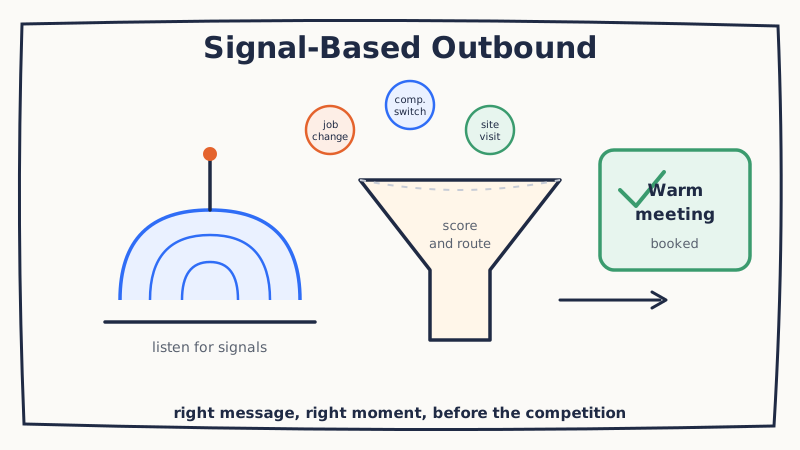
Short answer: A buyer intent signal is any observable event that tells you an account is more likely to buy right now than it was yesterday. In 2026 the outbound teams that win are the ones that listen for these signals, score them, and reach the buyer within hours instead of blasting a static list once a quarter. The seven signals worth building a system around are job changes, competitor switches, funding events, hiring surges, website and content engagement, technology changes, and product usage milestones. Chase those, drop everything else, and your reply rates climb because you are contacting people at the exact moment their problem is loud.
The rest of this post breaks down each signal, how to score them, and how to wire the whole thing together so a signal turns into a booked meeting before a competitor even notices the account moved.
What is a buyer intent signal, really?
Most “intent data” you can buy is a probability score bolted onto a company logo. It tells you an account is “in-market” without telling you why or what to say. That is a start, but it is not a signal you can act on with confidence.
A real buyer intent signal has three properties:
- It is a specific event, not a vague score. “Their VP of Sales started three weeks ago” beats “intent score: 78.”
- It is timely. The value of a signal decays fast. A job change is gold in week one and lukewarm by week eight.
- It tells you what to say. The signal itself hands you the opening line, so the message writes itself.
When a signal has all three, you stop guessing about timing and messaging. You already know both. That is the entire premise of signal-based selling, and it is why teams working with GroomLead build their outbound around events rather than static lists.
The 7 buyer intent signals worth chasing in 2026
Not every signal is worth the engineering. These seven carry enough intent to justify a dedicated play.
1. Job changes (the highest-intent signal in B2B)
When a past champion lands a new role, they arrive with a fresh budget, new problems, and a memory of a product that worked. When a new executive joins a target account, they are actively looking to make an early win. Both are among the strongest signals you can act on, which is exactly why we built Champions to track customer and champion job moves and turn them into warm pipeline the moment they happen.
2. Competitor switches and dissatisfaction
An account publicly griping about a competitor, letting a competing contract lapse, or removing a rival’s tech from their stack is telling you the door is open. Reaching those accounts requires monitoring competitors continuously, not checking once a month. That is the entire job of GetCam, which watches competitor websites and pricing for the changes that trigger a switch, so your rep lands in the inbox while the buyer is still frustrated.
3. Funding and financial events
A fresh Series A or B means new budget and pressure to grow into the valuation. New funding is one of the few signals where the buyer expects to be pitched, because everyone knows they just raised money to spend.
4. Hiring surges
A company posting ten sales roles in a month is scaling a go-to-market motion, which means they are about to feel every gap in their tooling and process. Job postings are public, cheap to monitor, and reveal the exact team that is about to have your problem.
5. Website and content engagement
Repeat visits to your pricing page, a demo request that stalled, or an account bingeing your comparison content is showing hand-raised intent. The catch is speed. Engagement signals decay in hours, not days, so the response has to be near instant.
6. Technology changes
An account adding a complementary tool (or ripping one out) reshapes what they need next. A team that just adopted a new CRM is in the market for everything that plugs into it.
7. Product usage milestones
For product-led teams, a workspace hitting a usage ceiling, inviting a fifth teammate, or finishing onboarding is a buy-now moment. These are the warmest signals of all because the buyer is already inside your product.
How to score buyer intent signals so you chase the right ones
Seven signals across thousands of accounts is more than any rep can triage by hand. You need a lightweight score so the strongest signals surface first. A simple model that works:
- Fit (0 to 40): How well does the account match your ICP? A perfect signal on a bad-fit account is noise.
- Signal strength (0 to 40): A former champion in a new VP seat scores near the top. A single pricing-page visit scores low.
- Recency (0 to 20): Full points inside 48 hours, decaying to near zero after three weeks.
Add them up, route anything over 70 to a human for a personal touch, send 40 to 70 into an automated sequence, and let anything under 40 wait for a second signal to stack. Signals compound. An account that shows two mid-strength signals in the same week is often a hotter lead than one showing a single strong one.
This scoring layer is where a data and orchestration tool earns its keep. Triguna sits between your signal sources and your sequencing tools, enriching each event and pushing only the scored, deduplicated accounts into your outbound so reps never wade through raw noise.
Turning a signal into a booked meeting
A signal is worthless if it dies in a spreadsheet. The path from event to meeting has four steps, and every one of them is a place where speed wins.
- Detect. Monitor your seven sources continuously. Manual checking guarantees you show up late.
- Score and route. Apply the fit, strength, and recency model above, then send each account to the right channel.
- Reach out with the signal in the first line. The message references the event directly. “Saw you just took the VP role at Acme” outperforms any clever template, because it proves you are paying attention.
- Respond in minutes when they reply. A signal-triggered reply is high-intent by definition, and making the buyer wait an hour throws away the advantage. This is why we run Underfive on every signal-based campaign, so interested replies get a context-aware answer in under five minutes instead of sitting until tomorrow.
For teams that want the full loop running without hiring a data engineer, VSDR chains detection, scoring, and first-touch outreach into an AI sales rep that works signals around the clock and hands the warm conversations to a human to close.
Signal-based outbound vs. traditional list-based outbound
Here is the difference in plain terms:
- List-based outbound picks a static list, writes one message, and blasts it on a schedule. Timing is random, so most contacts are reached when their problem is quiet. Reply rates stay low no matter how good the copy is.
- Signal-based outbound waits for an event, reaches the account while the problem is loud, and leads with the signal. Fewer contacts, far higher reply rates, and a message that never feels cold because it is not.
The volume looks smaller on paper. The pipeline looks bigger in the CRM, because you are spending your outreach budget on the accounts that are actually ready.
How to start signal-based selling this quarter
You do not need to build all seven plays at once. Start with the single highest-intent signal for your business, prove the lift, then layer in the next one.
- Pick one signal. For most B2B teams, job changes or competitor switches are the fastest to show results.
- Wire up one source. Point a monitoring tool at that signal and let it run.
- Write one signal-led sequence. Three touches, each referencing the event.
- Measure reply rate against your list-based baseline. When it wins (it will), add the next signal.
Signal-based outbound is not a tool you buy, it is a discipline you build. The teams pulling ahead in 2026 treat every buying signal as a countdown clock and race to be the first relevant message in the inbox. If you want help standing up the detection, scoring, and outreach layers as one system, that is exactly the kind of GTM engineering GroomLead does.
Frequently asked questions
What is the highest-intent buyer signal? A job change involving a past champion or a new executive at a target account. Both combine fresh budget, a live problem, and a reason to expect your outreach.
How fast do intent signals decay? It varies by type. Website engagement decays in hours, job changes stay warm for a few weeks, and funding events hold value for a couple of months. Score recency accordingly.
Do I need intent data vendors to do this? No. Many of the strongest signals (job changes, hiring surges, competitor moves, funding) are public. Vendors and monitoring tools save you the manual labor of watching for them at scale, but the signals themselves are free to observe.
Is signal-based outbound just for enterprise teams? No. It works at any size, and smaller teams often benefit most, because focusing a limited outreach budget on ready-to-buy accounts is exactly how you compete with a bigger sales org.
Ready to engineer your own GTM system?
GroomLead builds the outbound infrastructure behind 100+ agencies, and the tools inside this post.
Book Strategy Call