How to Build a B2B Lead Qualification Framework That Prioritizes the Leads Worth Working in 2026
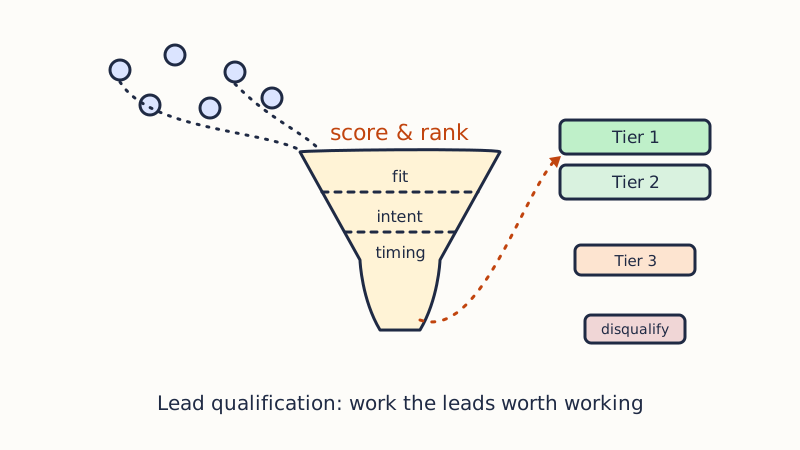
Most sales teams do not have a lead problem. They have a prioritization problem. Reps get a list, work it top to bottom, and spend the same effort on a company that will never buy as they do on the account that is ready to sign this quarter. A lead qualification framework fixes that. It is the scoring layer that decides which leads get worked hard, which get a light touch, and which get dropped, so your selling hours land on the accounts most likely to convert. Here is how we build lead qualification at GroomLead, and how to build one that survives contact with a real pipeline.
What is lead qualification?
Lead qualification is the process of evaluating a lead against a defined set of criteria to decide whether, and how urgently, it is worth pursuing. A qualified lead is one that matches your ideal customer profile, shows evidence of a need or buying intent, and can realistically buy in a useful timeframe. Qualification turns an undifferentiated list into a ranked queue.
It answers three questions for every lead: Is this the right kind of company and person? Is there a reason to believe they need us? And is now a plausible time to buy? A lead that fails all three is noise. A lead that passes all three is where your next meeting comes from.
Lead qualification vs your ICP: how they differ
An ideal customer profile defines the type of company worth targeting at all. Lead qualification operates one level down: it scores the individual leads that enter your funnel against that profile plus their observed behavior. The ICP is the map; qualification is deciding which specific roads to drive today.
You need both. A tight ICP keeps bad-fit companies off the list in the first place, and qualification then ranks the in-profile leads by how ready they actually are. Skipping qualification means treating every in-ICP lead as equally urgent, which is how good accounts go cold while reps chase ones that were never close.
The three dimensions every qualification framework needs
Durable qualification scores a lead on three independent dimensions. A lead can be strong on one and weak on another, and the combination is what determines the tier.
1. Fit
Does the lead match your ICP on the attributes that predict a good customer? Industry, company size, business model, tech stack, and the role of the specific person. Fit is the most stable dimension because it rarely changes week to week. It sets the ceiling: a poor-fit lead almost never becomes a good customer no matter how interested they seem.
Fit scoring is only as good as your data. Stale titles, wrong headcounts, and missing technographics quietly corrupt the score. Triguna returns structured, current firmographic and contact data from a company identifier or LinkedIn profile in a single API call, so the attributes you score on are real and current rather than a year-old export.
2. Intent
Is there evidence this company needs what you sell right now? Intent shows up as behavior and events: a relevant hire, a new office, a product launch, a tooling change, or activity on your own site and content. Intent is what separates a company that merely looks like a fit from one that is actively moving toward a decision.
CAM monitors target and competitor company websites for the changes that signal a buying window, so intent enters your score as observed events rather than a guess. A lead with strong fit and a fresh intent signal should jump the queue past a same-fit lead with no signal at all.
3. Timing and reachability
Can they buy soon, and can you actually reach the right person? A perfect-fit, high-intent lead is still worthless this quarter if the budget is frozen or the only contact you have left the company. Timing captures buying window and reachability captures whether current contact data lets you start a real conversation.
The warmest timing signal of all is relationship. When a past champion, someone who already trusts your product, changes jobs, their new company becomes a top-priority lead the week it happens. Champions surfaces those job changes the moment they occur, turning existing goodwill into a pre-qualified, well-timed lead.
BANT vs MEDDIC: which qualification model to use
Two named frameworks dominate B2B qualification. They are not competitors so much as tools for different stages and deal sizes.
- BANT (Budget, Authority, Need, Timing) is a fast, four-question filter best for high-volume, lower-complexity deals. It is what a rep or an SDR runs on an early call to decide whether a conversation is worth escalating. Its weakness is that it can disqualify good early-stage deals where budget is not yet allocated.
- MEDDIC (Metrics, Economic buyer, Decision criteria, Decision process, Identify pain, Champion) is a deeper framework for complex, multi-stakeholder, higher-value deals. It qualifies not just whether to pursue, but how to win, by mapping the buying process and the people in it.
For most outbound-driven pipelines, use a lightweight fit-intent-timing score to prioritize the top of the funnel, then apply BANT on first conversations and graduate qualifying opportunities into MEDDIC as they enter the sales cycle. Match the depth of qualification to the value and complexity of the deal.
MQL vs SQL: getting the handoff right
Two definitions cause more marketing-to-sales friction than any other:
- A marketing qualified lead (MQL) has shown enough interest (a demo request, a content download, repeat site visits) to be worth a sales touch, but has not been vetted by a human.
- A sales qualified lead (SQL) has been reviewed by sales, meets the fit and intent bar, and is accepted as worth active selling time.
The handoff breaks when the two teams do not agree on the SQL bar. The fix is a written, shared definition of what makes a lead sales-ready, plus a fast feedback loop where sales marks why a lead was rejected. Those rejection reasons are gold: they tell marketing exactly which sources and segments produce leads that do not convert, so the top of the funnel gets tighter over time.
How to build your lead scoring model
Turn the three dimensions into a simple, defensible score. Keep it transparent enough that a rep can look at a lead and understand why it ranked where it did.
- Assign points per dimension. Give fit, intent, and timing each a weighted point range. Weight fit highest for durability, but let a strong intent signal meaningfully raise a lead’s rank.
- Set tier thresholds. Translate total scores into Tier 1 (high fit plus a live intent or timing signal), Tier 2 (strong fit, weaker signals), and Tier 3 (acceptable fit, work at volume). Everything below the floor is disqualified, not stored as false hope.
- Write disqualifiers explicitly. Competitor, existing customer, wrong region, too small, no reachable contact. An automatic disqualifier overrides a high score.
- Tie every rule to evidence. If a scoring rule cannot point to a pattern in your actual closed-won and closed-lost data, it is a guess. Label it a hypothesis and test it rather than baking it in.
The goal is not a perfect algorithm. It is a consistent, explainable ranking that two different reps would reproduce from the same data.
Turning qualified leads into booked meetings
Qualification only creates pipeline when the tiers actually change how leads get worked. A score that sits in a spreadsheet changes nothing.
- Match effort to tier. Tier 1 leads earn researched, individually written outreach. Tier 3 gets a lighter but still relevant touch. Never spend Tier 1 effort on Tier 3 leads.
- Work the full qualified list at a human pace. This is where hand-built outbound stalls, because researching and writing per lead does not scale by headcount. VSDR deploys an AI sales development rep that researches each qualified lead and writes individually personalized messages across the full sequence at a controlled, human-like sending pace, so a well-scored list gets worked thoroughly instead of sampled.
- Respond to interest within minutes. A reply from a high-tier lead is the most valuable event in the funnel, and it cools within hours. Underfive.ai categorizes and drafts replies to inbound responses within minutes, so an engaged, qualified prospect gets booked while the interest is still warm.
What to measure to refine qualification
Your first scoring model is a hypothesis. Instrument it so real outcomes tighten it:
- Conversion rate by tier, to confirm that Tier 1 actually converts better than Tier 2 and 3. If it does not, your weights are wrong.
- Positive reply rate by fit and intent segment, so you can see which attributes and signals truly predict engagement and prune the ones that do not.
- Win rate and retention by qualified cohort, the truest test, because a lead that buys and stays validates the score in a way a reply never can.
- SQL rejection reasons, tracked as a list, so recurring “not qualified” patterns feed straight back into your fit criteria and disqualifiers.
Review the model quarterly against these numbers. Cut the rules that do not predict revenue and reinforce the ones that do.
A quick-start lead qualification checklist
- Score every lead on three dimensions: fit, intent, and timing.
- Enrich and verify each lead’s data before you score it, so the score is built on current facts.
- Add intent and relationship signals so ranking reflects readiness, not just resemblance.
- Set clear Tier 1, 2, and 3 thresholds plus explicit automatic disqualifiers.
- Agree on a written SQL definition with a fast sales-to-marketing feedback loop.
- Match personalization effort to tier and work the full qualified list at a human cadence.
- Reply to high-tier interest within minutes, not days.
- Measure conversion, win rate, and rejection reasons by tier, then tighten quarterly.
A lead qualification framework is not paperwork. It is the filter that decides where every selling hour goes, and it is one of the highest-leverage levers you have on pipeline efficiency. If you would rather have that scoring built, worked, and continuously refined for you than assemble it in-house, that is exactly the outbound engine GroomLead runs for its clients every day.
Ready to engineer your own GTM system?
GroomLead builds the outbound infrastructure behind 100+ agencies, and the tools inside this post.
Book Strategy Call