How to Build a B2B Lead List for Cold Outbound That Actually Books Meetings in 2026
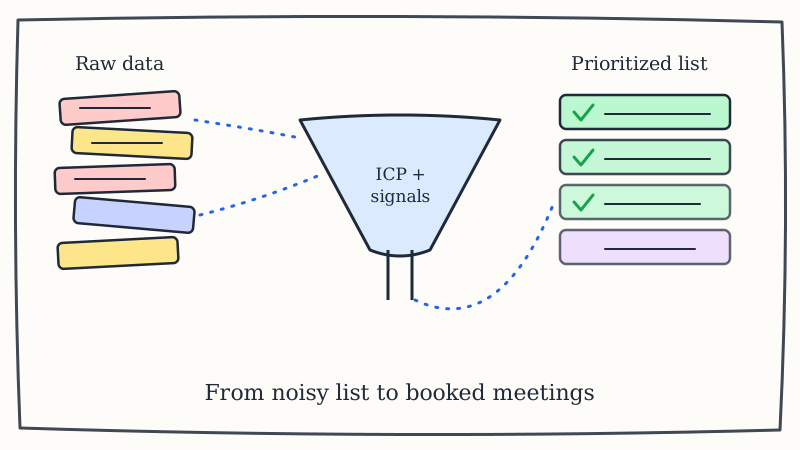
Most outbound teams do not have a messaging problem. They have a list problem. You can write the sharpest cold email in your category, but if it lands in the inbox of someone who does not fit your profile, is not in a buying window, or left the company two quarters ago, the reply rate is still zero. The lead list is the single input that decides whether outbound has a chance before a word gets written. This guide lays out how to build a B2B lead list in 2026 that is sourced deliberately, enriched with current data, ranked by real buying signals, and run as one instrumented system with GroomLead rather than a static export you bought and never touched again.
What makes a good B2B lead list?
A good lead list is not a big list. It is a list where every contact is a plausible buyer today, reachable at a valid address, and ordered so your reps work the highest-probability accounts first. Volume without those three properties just spreads the same number of real opportunities across more wasted sends, which drags down your reply rate and puts your sending domain at risk.
Three properties separate a list that books meetings from one that burns your reputation.
- Fit. Every account matches your ideal customer profile on the dimensions that actually predict a purchase: industry, size, tech stack, and the presence of the problem you solve.
- Freshness. Every contact record reflects the person’s current role and company, not a title they held before their last two moves.
- Priority. The list is ranked, not flat. The accounts showing a reason to buy right now sit at the top, and the cold-but-fitting accounts sit in a nurture tier below them.
Get those three right and a list of 400 accounts will outperform a purchased database of 40,000 every quarter.
How do you source contacts for a B2B lead list?
Sourcing is where most teams reach for a single database, export fifty thousand rows, and call it a pipeline. The better approach treats sourcing as a blend of channels, each of which surfaces accounts the others miss.
- Your ideal customer profile, applied as a filter. Start from a written ideal customer profile and use it to query firmographic databases for the accounts that match. This is your fit-based core.
- Competitor customer bases. The companies already using a competing product have the budget, the pain, and the vocabulary to buy what you sell. Watching who adopts, mentions, or reviews a rival is one of the richest sources of qualified accounts, and a monitoring tool like CAM turns competitor and technographic footprints into a live feed of accounts worth adding to the list.
- Signal-driven inbound-adjacent lists. People who visited your pricing page, opened a past campaign, or engaged with your content are warmer than any cold pull. Pipe those into the same list-building motion instead of leaving them in a separate silo.
- Referral and network expansion. For every closed customer, the lookalike accounts in the same segment are natural next targets.
The point is not to run all four every week. It is to know that a list built from only one source will always be blind to the accounts the other three would have surfaced.
Why does list data decay so fast?
A B2B contact list starts rotting the moment you build it. People change jobs, companies get acquired, titles shift, and email formats change after a rebrand. Industry data puts B2B data decay at roughly 25 to 30 percent per year, which means a list you sourced in January is meaningfully wrong by summer. Sending to those stale records is not harmless. Every message to a dead mailbox is a hard bounce, and a high bounce rate is one of the fastest ways to convince a mailbox provider that you are a spammer.
This is why enrichment cannot be a one-time step at the point of purchase. The list has to be re-verified close to the moment you send, so the record you act on is the record as it exists today, not as it existed when a database vendor last crawled it. Building that refresh into the list-building motion, rather than treating the export as final, is the difference between a list that stays accurate and one that quietly decays under you.
How do you enrich a lead list with current data?
Enrichment is the step that turns a name and a company into a record you can actually act on: verified email, current title, seniority, department, company size, and the firmographic details your qualification logic needs. Two things make enrichment reliable in 2026.
The first is doing it programmatically at the moment of use. A single API lookup against a domain or profile can return structured, current role and company data on demand, so you enrich at build time and again before a send rather than trusting a months-old export. An enrichment API like Triguna is built for exactly this: hand it a domain or a profile and it returns clean, structured firmographic and work-history data you can drop straight into your list logic.
The second is verifying the deliverable address separately from enriching the record. A valid-looking email is not the same as a mailbox that accepts mail. Running each address through validation before it enters the send queue is what protects the deliverability you spent months earning. A record that is enriched but unverified is still a bounce risk, so the two steps belong together in the same pipeline.
What buying signals should you layer onto the list?
Fit tells you who could buy. Signals tell you who might buy now. A list ranked by signals books meetings faster because your reps spend their first hours on the accounts with a live reason to talk, not on the alphabetical top of a flat export.
The signals worth capturing in 2026 fall into a few families:
- Job changes. When a champion who knew your product moves to a new company, they arrive with budget, authority, and a mandate to change things. That window is short and enormously high-converting. Tracking customer and prospect job changes with a tool like Champions turns each move into a warm, timed reason to reach out.
- Hiring signals. A company posting for roles adjacent to your problem is telling you they are investing in that area right now.
- Technographic changes. Adoption or removal of a specific tool in the stack signals a shift you can time your outreach to.
- Competitive and market events. A competitor raising prices, sunsetting a product, or having an outage is a reason for their customers to look, and monitoring those events surfaces the accounts in motion.
You do not need every signal. You need at least one reliable signal source feeding the list so the ranking reflects timing and not just fit.
How do you prioritize and score the list?
Once the list is sourced, enriched, and signal-tagged, it has to be ordered. A flat list forces every rep to make the same guess about where to start, and most guess wrong. A scored list makes that decision once, centrally, and correctly.
A workable score combines two axes:
- Fit score. How closely the account matches your ideal customer profile, weighted toward the attributes that historically correlate with closed deals rather than the ones that are simply easy to filter on.
- Signal score. How strong and how recent the buying signals are on that account, with a job change this week outranking a technographic match with no timing behind it.
Multiply or stack the two and you get tiers. The top tier gets your best reps and your most personalized outreach. The middle tier gets a lighter, still-relevant sequence. The bottom tier goes into nurture until a signal promotes it. This is also where a phone-and-voice channel earns its place: for the highest-priority accounts, a well-timed call layered onto the email sequence lifts connect rates, and a voice-outbound system like VSDR lets you add that channel to the top tier without hiring a room full of dialers.
Should you buy a lead list or build one?
Buying a pre-packaged list is tempting because it is fast, but a purchased list is a static snapshot the moment it lands, sold to everyone else in your category, and disconnected from your signals. It optimizes for the one metric that does not matter, raw count, and ignores fit, freshness, and priority.
Building a list is not slower in any way that hurts you, because the build is a repeatable system rather than a one-time purchase. You define the profile once, wire in the sources, run enrichment and validation on a schedule, layer signals, and let the score reorder the list as the world changes. The output is a living list that gets more accurate over time instead of less. If your team is small, this is exactly the kind of system worth handing to a partner: GroomLead builds and runs the whole list-building motion as instrumented infrastructure, so you get a fresh, ranked, deliverable list feeding your reps without standing up the tooling yourself.
What does a good list-building workflow look like end to end?
Put the pieces together and the workflow is a loop, not a project with an end date.
- Write the ideal customer profile and translate it into concrete filters.
- Source candidate accounts from firmographic queries, competitor footprints, and engaged contacts.
- Enrich every record with current role and firmographic data through an API like Triguna, then validate each email before it can enter a send queue.
- Layer buying signals: job changes from Champions, competitive and technographic events from CAM.
- Score each account on fit plus signal, and sort the list into tiers.
- Route the top tier to multi-channel sequences, including voice via VSDR where it fits.
- Re-run enrichment, validation, and scoring on a cadence so the list refreshes itself.
Run that loop and your list stops being a decaying asset you bought and becomes a compounding one you own.
The takeaway
The lead list is the highest-leverage input in outbound, and in 2026 the teams that win treat it as living infrastructure rather than a static purchase. Source from more than one channel, enrich and validate close to the moment you send, layer in the signals that reveal timing, and score the whole thing so your reps always work the right accounts first. Do that and every downstream metric, from reply rate to booked meetings, improves because the input finally deserves the effort. If you would rather run that system than build it, GroomLead builds fresh, ranked, deliverable lead lists as part of a full outbound motion, and you can talk to the team about standing yours up.
Ready to engineer your own GTM system?
GroomLead builds the outbound infrastructure behind 100+ agencies, and the tools inside this post.
Book Strategy Call