B2B Data Decay in 2026: Why Your CRM Rots and How to Keep Outbound Lists Clean
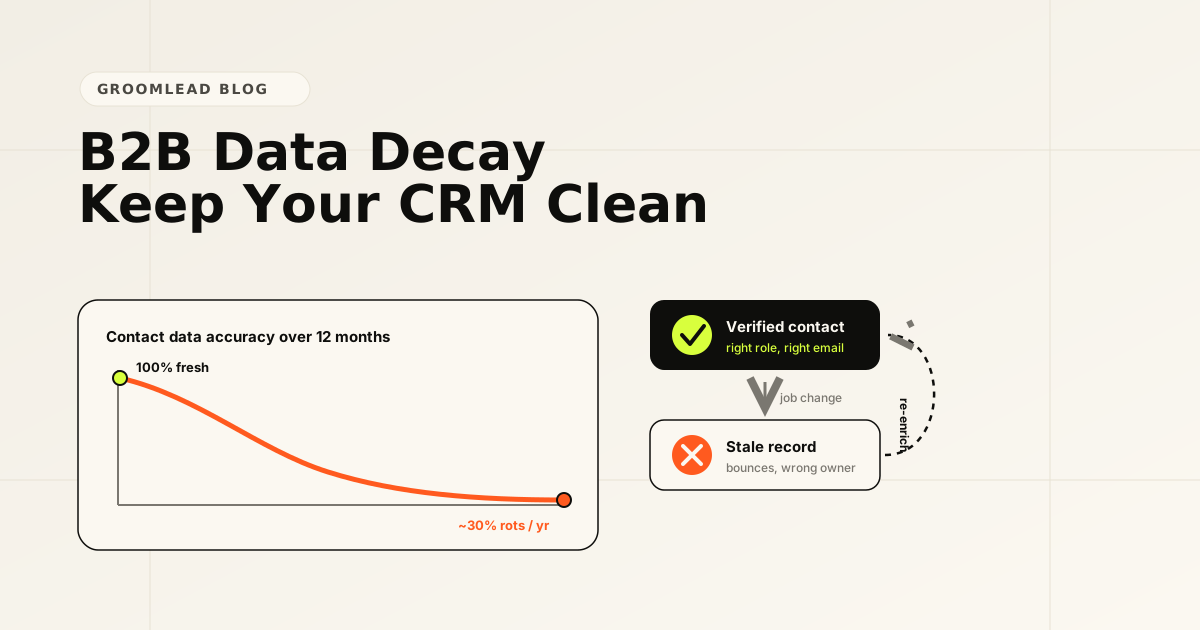
Short answer: B2B data decay is the steady rate at which the contact and account records in your CRM go wrong: people change jobs, companies get acquired, emails start bouncing, and titles shift. Industry estimates put the decay rate at roughly 2.5% to 3% per month, which compounds to about 30% of your database going stale every year. That decay is invisible until it shows up as bounced sends, hurt deliverability, and reps working leads that moved on months ago. You cannot stop decay, but you can keep it from rotting your pipeline by treating enrichment as a continuous system: detect the change, re-verify the record, and re-route it, instead of buying a fresh list once a year and watching it degrade.
The rest of this post covers what data decay actually is, how fast it happens, what it quietly costs your outbound, and the exact hygiene loop GroomLead builds so a CRM stays clean without a quarterly manual scrub.
What is B2B data decay?
Data decay is the gap between what your CRM says about a contact and what is actually true right now. A record you enriched in January said “VP of Sales, [company], verified email.” By June that person may have been promoted, switched companies, or left the workforce, and the company may have rebranded, moved, or been acquired. None of that updates itself. The record just sits there, quietly wrong, until someone sends to it.
Decay comes in two flavors. Contact-level decay is about people: job changes, promotions, departures, and the email addresses that die with them. Account-level decay is about companies: mergers, acquisitions, funding events, headcount swings, tech-stack changes, and closures. Both matter for outbound, because a message is only relevant if the person and the company are still who your data claims they are.
The reason this is a first-class problem in 2026 is that the modern GTM motion is built entirely on data. Every sequence, every scoring model, every routing rule assumes the underlying record is accurate. When the record rots, everything downstream inherits the error, which is why teams working with GroomLead treat data hygiene as infrastructure rather than a chore.
How fast does B2B data decay?
Fast enough that a list you consider “fresh” is measurably worse a quarter later. The widely cited benchmarks land in a consistent range:
- Contact records decay at roughly 2.5% to 3% per month. Over a year that is about 30% of your database gone stale, and the churn is heaviest among exactly the senior decision-makers you most want to reach.
- Around one in three professionals changes roles in a given year. Every one of those moves creates a dead email and, usually, a new buying committee somewhere else.
- B2B email lists degrade even faster than the contacts themselves, because a single job change can invalidate the email, the direct dial, the title, and the company all at once.
The compounding is the part teams underestimate. Decay is not a one-time 30% haircut you can patch in December. It is a monthly bleed, so a database refreshed once a year spends most of the year drifting further from reality. By month eleven you are running outbound against data that is nearly a full cycle out of date.
What does data decay actually cost outbound?
The cost is rarely a single line item, which is why it hides. It shows up as four separate leaks:
- Deliverability damage. Sending to decayed addresses drives bounces, and bounce rate is one of the strongest signals mailbox providers use to decide whether your domain lands in the inbox or spam. A dirty list does not just waste the bounced sends, it degrades delivery for the good addresses on the same domain.
- Wasted rep time. Every hour a rep spends researching, calling, and following up on a contact who left six months ago is an hour not spent on a live opportunity. At scale this is a large, silent tax on the whole team.
- Missed warm opportunities. When a champion changes jobs, that is not just a dead record, it is your single warmest new lead: someone who already knows your product, arriving at a new company with buying authority. If your data quietly marks them “bounced” and moves on, you miss the best opportunity in your funnel.
- Broken scoring and routing. Lead scores and routing rules run on firmographic and title data. When that data is stale, high-fit accounts get mis-scored and mis-routed, so the automation you built to be efficient starts working against you.
Add these up and decayed data is not a data-quality footnote. It is a direct drag on pipeline, deliverability, and every dollar you spend generating leads.
The B2B data hygiene loop
You cannot prevent decay, so the answer is not a bigger annual scrub. It is a continuous loop that catches each record the moment it goes wrong and repairs it. Here is the loop GroomLead builds, and the layer that owns each step.
1. Detect the change as it happens
The clock on a stale record starts the instant a person moves or a company changes, so detection has to be event-driven rather than a batch you re-buy each quarter. The highest-value signal is the job change, because it simultaneously kills an old record and creates a warm new one. This is exactly what Champions watches for: it monitors your customers and past champions for role changes and surfaces the move the moment it happens, so a departure becomes a warm lead instead of a silent bounce. Account-level changes matter too, and monitoring competitor and market shifts is the job of GetCam, which tracks competitor sites and pricing so a company change becomes a timely signal rather than a surprise.
2. Re-verify and re-enrich the record
A detected change is only useful if the record gets corrected. When a contact moves, the loop should immediately re-enrich: find the new company, the new title, the new verified email, and the new fit score, then write it back so the CRM reflects reality instead of history. Triguna sits in this enrichment-and-routing layer, taking each change event and pushing a clean, scored, correctly-attributed record downstream so nothing is left to rot in a queue.
3. Re-route and act while the signal is warm
A freshly repaired record is perishable in the same way an inbound lead is. A champion who just started a new role is at peak receptivity in the first days, so the repaired record should route straight into outreach rather than waiting for the next campaign. For teams that want the whole detect-enrich-route-respond chain running without building it in-house, VSDR strings those steps into an AI sales rep that works the signal around the clock, and Underfive answers the interested replies in under five minutes so a warm, re-enriched lead is talking to you while intent is still high.
4. Measure decay, do not just react to it
The loop only stays honest if you watch it. Track bounce rate over time, the share of records with a verified email, and the age of your data. When those numbers drift, it is decay talking, and it is cheaper to tune the loop than to buy your way out with another list.
Buy-a-list versus continuous hygiene
Most teams still run the buy-a-list model: purchase or scrape a batch, load it, work it until bounce rates get embarrassing, then buy again. That model is structurally at war with decay, because the list is at its best on day one and degrades every day after. You are always working the average of “fresh” and “nearly a year stale.”
The continuous-hygiene model inverts it. Instead of periodically replacing everything, you repair each record as it breaks. The database is never perfect, but it never drifts far from reality either, because the loop is always pulling it back toward accurate. Over a year, the continuous approach beats the batch approach on deliverability, on rep efficiency, and especially on warm-opportunity capture, since the job changes that a batch model treats as bounces are exactly the leads a hygiene loop treats as gold.
The bottom line
B2B data decay is not a question of if, it is a rate, and that rate is fast enough to quietly hollow out an outbound program in a single year. You cannot stop your contacts from changing jobs or your target accounts from getting acquired. What you can do is stop treating your CRM as a static asset and start treating it as a live system that detects each change, re-verifies the record, and re-routes it while the signal is warm. Do that and decay stops being a tax and starts being a source of your best leads. If you want help wiring the detection, enrichment, and routing layers into one clean loop, that is the kind of GTM engineering GroomLead does.
Frequently asked questions
What is a normal B2B data decay rate? Roughly 2.5% to 3% of contact records per month, which compounds to about 30% per year. The rate is higher among senior decision-makers, who change roles more often, so the most valuable slice of your database also decays the fastest.
How often should I clean my CRM data? Continuously, not quarterly. Because decay is a monthly bleed, a periodic scrub means you spend most of the year working drifting data. The better model is an event-driven loop that repairs each record the moment it changes, so hygiene is structural rather than a calendar task.
Is a job change bad for my data? It breaks the old record, but it is the best signal in your funnel. A champion moving to a new company is a warm lead who already knows your product and now has buying authority. Treated as a bounce it is a loss; detected and re-enriched, it is often your highest-converting opportunity.
How does data decay hurt email deliverability? Sending to decayed addresses drives bounces, and mailbox providers use bounce rate to decide inbox placement. A dirty list therefore hurts delivery for your good addresses too, not just the dead ones, which is why list hygiene and deliverability are the same problem.
Can I just buy a fresh list instead of maintaining hygiene? You can, but it fights the math. A purchased list is best on day one and decays every day after, so you are always working stale-on-average data and treating your warmest job-change leads as bounces. A continuous hygiene loop keeps the database close to reality and captures those changes as opportunities.
Ready to engineer your own GTM system?
GroomLead builds the outbound infrastructure behind 100+ agencies, and the tools inside this post.
Book Strategy Call