B2B Contact Data Enrichment in 2026: How Waterfall Enrichment Keeps Your Outbound List Accurate
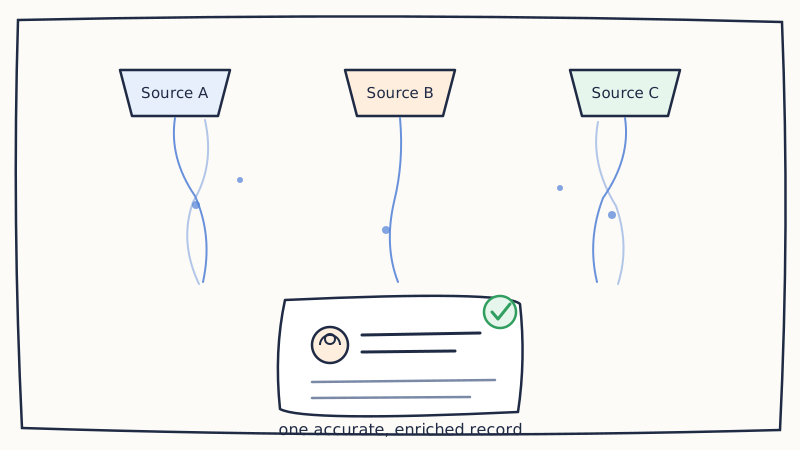
Outbound runs on the quality of one thing: the contact record. A perfectly targeted account is worthless if the email bounces, the title is two roles out of date, or the phone number belongs to someone who left last year. Contact data enrichment is how you turn a thin, half-empty row into a record complete and current enough to act on. This guide explains what enrichment actually does in 2026, why a single data vendor is never enough, how waterfall enrichment fixes the coverage problem, and how to keep enriched records from rotting the week after you build them. GroomLead runs enrichment as a standing system rather than a one-time cleanup, and you can see how that fits an outbound motion at GroomLead.
What is B2B contact data enrichment?
B2B contact data enrichment is the process of filling in and correcting the missing fields on a contact or account record using external data sources. You start with a partial record, often just a name and a company or a LinkedIn URL, and enrichment adds the work email, direct phone, current title, company size, industry, tech stack, and other firmographic details you need to qualify and reach the person.
Enrichment does two distinct jobs, and it helps to keep them separate.
- Completion. Filling empty fields on a record that never had them, such as adding a verified work email to a name you pulled from a conference attendee list.
- Correction. Overwriting fields that were once right but have gone stale, such as updating a title after a promotion or fixing an email format after a company rebrand.
Most teams think of enrichment as completion only. In practice, correction is where the recurring value lives, because a B2B record does not stay accurate for long.
Why isn’t a single data provider enough?
No single data provider has good coverage of every contact you care about. Every vendor builds its database from a particular set of sources, so each one is strong in some segments and weak in others. One provider might have excellent coverage of North American software companies but thin data on European manufacturers. Another might have direct dials for enterprise executives but almost nothing for startups.
When you rely on one vendor, you inherit its blind spots. A typical single-source enrichment run returns a verified email for maybe 45 to 65 percent of your list, and you are left guessing on the rest. Those gaps are not random. They cluster in exactly the accounts a single database underserves, which means a whole segment of your target market quietly falls out of your outreach before a rep ever sees it.
The instinct is to buy a second database and run it too. That works, but doing it by hand is slow, and you end up with conflicting values for the same field and no rule for which one to trust. That is the problem waterfall enrichment is built to solve.
What is waterfall enrichment?
Waterfall enrichment is a method that queries multiple data providers in a set order and stops as soon as one returns a verified value for the field you need. Instead of betting on one vendor, you chain several. The record cascades down through provider one, then provider two, then provider three, until a field is filled with a trustworthy answer or the list of sources is exhausted.
The mechanics are straightforward.
- Define the priority order. Rank your providers per field based on their known accuracy for that data type and segment. The most reliable source for work emails may not be the best source for direct dials, so the order can differ by field.
- Query in sequence, not in parallel bulk. Send the record to the first provider. If it returns a verified value, accept it and stop. If not, pass the record to the next provider.
- Verify before you accept. A value is only worth keeping if it passes a validation check, such as an email that resolves to a real, active mailbox. An unverified guess is worse than a blank, because it produces a bounce.
- Record provenance. Store which provider supplied each field and when. That history is what lets you tune the order over time and audit a bad record later.
Run this way, a waterfall commonly lifts verified coverage from the 50 percent range of a single source into the 80s, and you only pay each downstream provider for the records the cheaper upstream sources could not fill. An enrichment API like Triguna is designed for exactly this: it takes a LinkedIn profile or company identifier and returns structured firmographic and work-history data in a single call, so it can sit as a strong node in a waterfall or anchor the whole chain for firmographic fields.
How do you keep enriched data from decaying?
Enriched data starts decaying the moment you finish enriching it. People change jobs, companies get acquired, titles shift, and email formats change after a rebrand. B2B contact data decays at roughly 25 to 30 percent per year, so a list you enriched in January is meaningfully wrong by summer. A one-time enrichment project is therefore a depreciating asset, not a permanent fix. We covered the mechanics of this in the B2B data decay and CRM hygiene guide, and the same logic applies to anything you enrich.
The fix is to treat enrichment as a continuous process instead of a project. Three habits keep a database current.
- Re-enrich on a schedule. Run your highest-value segments back through the waterfall on a recurring cadence so corrections land before the data drifts too far.
- Enrich on trigger, not just on a timer. The most valuable correction is a job change, because a champion who moves to a new company is warm pipeline. A tool like Champions watches your existing customers and closed-lost contacts for role changes and syncs the update into Salesforce, HubSpot, or Pipedrive the moment it happens, so the record fixes itself and a rep gets the signal at the same time.
- Enrich at the point of entry. When a new lead enters from a form, a signal, or a list import, enrich it immediately rather than letting a stale row sit until the next batch. Fresh-at-entry data is the cheapest kind to maintain.
Enrichment and monitoring are two halves of the same job. Correcting what you already have, and watching for the changes that make it wrong.
Where does enrichment fit in the outbound workflow?
Enrichment sits between sourcing and sequencing. You source a list of accounts that fit your profile, enrich the contacts so they are complete and verified, then hand a clean, current record to whatever sends the message. Placing it there means every downstream step operates on data it can trust, and no rep burns a send on a dead address.
That position also makes enrichment the natural place to attach scoring and signals. Once a record is enriched, you know enough about the account to rank it, and you can layer buying signals on top. CAM tracks competitors’ website activity and new connections, which tells you whether an enriched account is in an active buying window or sitting cold. Feeding that context in alongside the firmographics turns a flat, enriched list into a prioritized one.
From there the enriched, scored record flows into execution. VSDR deploys an AI virtual sales development rep that researches the account and writes a personalized first touch off the enriched context rather than a generic template, and when a prospect replies, Underfive.ai categorizes and drafts a context-aware response within minutes so the conversation keeps moving while intent is still hot. The through-line is that all of it depends on the record being right first. Enrichment is the input that makes every later step worth doing.
What does good enrichment look like in practice?
Good enrichment is measured, not assumed. If you cannot say what percentage of your list has a verified email and how old the average record is, you do not have an enrichment process, you have a pile of data of unknown quality. Track a small set of numbers and the system becomes tunable.
- Verified coverage rate. The share of your active list with a validated email and, where relevant, a direct dial. This is the headline number a waterfall is built to raise.
- Bounce rate on enriched contacts. The proof that verification is real. If enriched records still bounce, a provider in your chain is returning guesses, and you should reorder or drop it.
- Average record age. How long since each record was last enriched or confirmed. Rising average age is an early warning that decay is outrunning your refresh cadence.
- Cost per verified contact. Waterfalls save money by only paying downstream providers for what upstream ones miss, so watch this to confirm the order is efficient.
Set those up once and enrichment stops being a black box. You can see which providers earn their place, which segments are underserved, and when your refresh cadence needs to speed up.
The takeaway
Contact data enrichment is not a one-time list-cleaning chore. It is the input layer that decides whether your outbound has a chance before a word gets written. A single provider leaves half your market in the blind spots, so chain several in a waterfall and take the first verified answer for each field. Then keep the enriched records current by re-enriching on a schedule, on trigger, and at the point of entry, because data that was accurate in January is wrong by summer. Run that way, enrichment becomes a standing system that feeds clean, current records into everything downstream. If you want that built and maintained as part of a full outbound motion rather than stitched together by hand, talk to GroomLead.
Ready to engineer your own GTM system?
GroomLead builds the outbound infrastructure behind 100+ agencies, and the tools inside this post.
Book Strategy Call