Multithreading B2B Deals in 2026: How to Reach the Whole Buying Committee With Signal-Driven Outbound
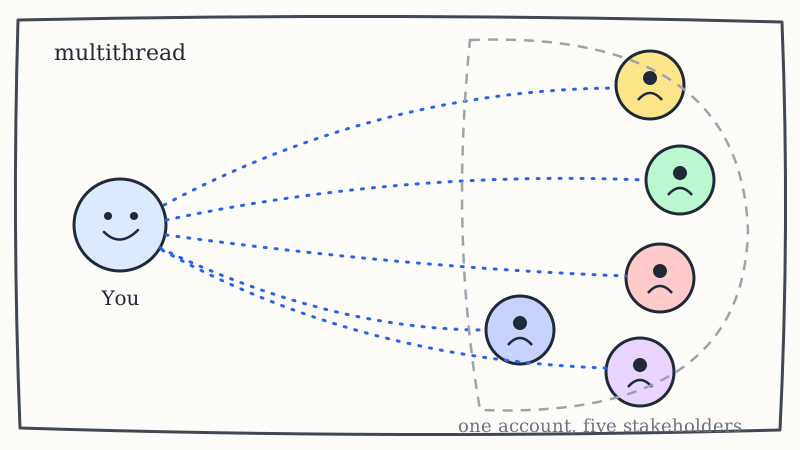
The single most common way a good B2B deal dies is quiet. Not a hard no, not a lost bake-off, just a champion who stops replying because the decision moved to a room they never invited you into. You spent the whole cycle threaded through one contact, and when that contact went dark, so did the deal. Multithreading is the fix: deliberately building relationships with every person who touches the buying decision, so no single point of failure can kill your pipeline. This guide lays out how to multithread B2B deals in 2026 using outbound that is mapped to the committee, personalized per role, and run as one instrumented system with GroomLead rather than a pile of disconnected one-to-one threads.
What is multithreading in B2B sales?
Multithreading is the practice of engaging multiple stakeholders inside a target account at the same time, instead of routing the entire relationship through a single contact. A single-threaded deal depends on one person to sell internally, defend the budget, and carry your message into rooms you cannot see. A multithreaded deal spreads that dependency across the economic buyer, the end users, the technical evaluator, and the internal skeptics, so the deal survives when any one of them goes quiet, leaves, or loses interest.
The reason it matters more every year is that buying committees keep growing. A typical B2B software purchase now involves six to ten people, and enterprise deals routinely run higher. Each of those people has a different fear, a different metric, and a different definition of a good outcome. Selling to one of them and hoping the message travels is a bet against the odds. Multithreading replaces that bet with coverage.
Why do single-threaded deals stall?
Single-threaded deals fail for reasons that have nothing to do with your product and everything to do with structure.
- Your champion has no authority. The person who loves your tool is often not the person who signs. If your only relationship is with an enthusiastic user, the deal stops the moment it reaches their boss.
- Your message degrades in transit. When your champion pitches internally, they leave out the parts that would answer the CFO’s objection, because they do not know the CFO has one. Your carefully built case arrives as a shrug.
- One departure ends everything. Buyers change jobs constantly. If your single thread leaves the company mid-cycle, you restart from zero with no warm relationship inside the account.
- Silence looks like coverage. A responsive champion feels like progress, so reps stop prospecting the account. The pipeline looks healthy right up until the deal vanishes.
Every one of these is a coverage problem, and coverage is something you can engineer before the deal is at risk rather than scramble for after it stalls.
How do you map a buying committee?
You cannot thread stakeholders you cannot name. The first job in any multithreaded motion is turning a company logo into a labeled org chart of the people who will shape the decision. There are four roles worth mapping on every serious account.
- The economic buyer. The person who owns the budget and signs. They care about business outcome and risk, rarely about features.
- The champion. The internal advocate who wants the change and will spend political capital on it. Usually a manager or senior individual contributor who feels the pain daily.
- The technical or functional evaluator. The person who vets whether the thing actually works: security, integration, workflow fit. They can veto without being able to approve.
- The end users. The people who will live in the product. Their enthusiasm or resistance quietly decides adoption, and smart buyers weight it heavily.
Mapping these roles by hand across a target list is where most teams give up, because the org data goes stale the moment you write it down. People change titles, switch teams, and leave. Enriching each account with current firmographic and work-history data at the moment you build the plan is what keeps the map honest. A single accurate profile lookup through an API like Triguna returns structured role and seniority data from a domain or profile, so you are threading the person who holds the budget today rather than the one who held it two quarters ago.
How do you reach every stakeholder without sounding like a template?
Once the committee is mapped, the failure mode flips. The risk is no longer under-coverage, it is sending five people the same message with the name swapped, and having them compare notes in a Slack channel you never see. Multithreading only works when each thread speaks to that person’s actual job.
The message to the economic buyer leads with business outcome and risk reduction, never with features. The message to the technical evaluator leads with how it fits their stack and what it does not break. The message to the end user leads with the daily annoyance it removes. Same account, same deal, four genuinely different opening lines, because four people are solving four different problems.
Doing that at volume across a full target list is the wall reps hit. Writing four role-specific, researched messages per account, times every account in the territory, is more hours than anyone has, so they default to the swapped-name template and lose the room. This is exactly the work worth handing to an AI layer that researches before it writes. Tools like VSDR deploy a virtual sales development rep that reads each stakeholder’s role and account context, then drafts and sends a personalized message across email and LinkedIn for every member of the committee, so coverage does not collapse the moment personalization gets expensive. The rep supplies the strategy and the guardrails; the system does the per-person drafting that no human can sustain at account scale.
When is the right moment to multithread an account?
Coverage without timing is just more noise arriving at once. The strongest multithreaded plays fire when something in the account has changed, because a change is what makes a committee willing to convene at all. Three timing signals are worth wiring into the motion.
- A champion lands. When someone who already knows and trusts your product changes jobs into a target account, you have a pre-warmed thread and a reason to open the others around them. That single move is the highest-leverage signal in outbound. We covered the full workflow in our guide to turning customer job changes into warm pipeline, and a tool like Champions surfaces those moves the day they happen so you thread the account while the relationship is still warm.
- An incumbent stumbles. When a competitor the account uses ships a price hike, an outage, or a painful change, the whole committee feels it at once, which is the rare moment they will all take a meeting. Watching for that trigger is the entire job of GetCam, which monitors competitor websites and pricing for the changes that make a buying group suddenly willing to switch.
- A reply comes in. The instant any thread answers, the window is open across the account, and the speed of your response decides whether the momentum survives. A same-day reply from a real research layer beats a next-morning one every time, which is why we run Underfive on signal-based campaigns so an interested stakeholder gets a context-aware answer in minutes instead of tomorrow.
How do you run multithreading as one system instead of five inboxes?
The operational trap in multithreading is that it multiplies the surface area of a deal by the size of the committee, and a rep juggling five threads per account across fifty accounts loses the plot fast. Two reps end up emailing the same VP, the technical evaluator gets the end-user message, and a reply sits unclaimed because nobody owned that thread. At that point multithreading is not coverage, it is chaos wearing coverage’s clothes.
The fix is to treat the account, not the contact, as the unit of work, and to instrument every thread inside it: who has been reached, in what role, with which message, and what came back. When the plan is built from live account data, the messages are drafted per role, the timing is driven by signals, and every reply routes to the right owner, multithreading stops being extra manual labor and becomes the default shape of the motion. That end-to-end orchestration, from account map to signal to per-stakeholder message to fast reply, is what GroomLead runs as a single instrumented system, so the committee is covered by design rather than by a rep’s heroics.
The takeaway
A B2B deal is not won by one great conversation with one great contact. It is won by being present, credibly and specifically, in every seat around the table where the decision actually gets made. Single-threading feels efficient because it is less work, right up until the thread goes quiet and the deal disappears with it. Multithreading is more work only if you do it by hand. Built as a system, where the committee is mapped from current data, each stakeholder gets a message written for their job, and the timing is driven by real account signals, it becomes the most durable motion in outbound: one where no single silence can kill the deal.
Ready to engineer your own GTM system?
GroomLead builds the outbound infrastructure behind 100+ agencies, and the tools inside this post.
Book Strategy Call