AI SDR vs Human SDR in 2026: The Real Cost, ROI, and When a Hybrid Outbound Team Actually Wins
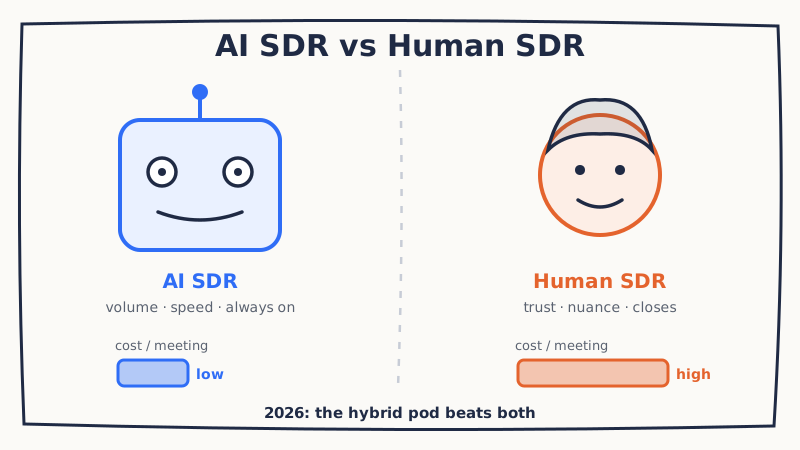
Short answer: A fully loaded human SDR costs roughly $120,000 to $200,000 per year once you add salary, commission, benefits, tooling, and management overhead. An AI SDR costs roughly $6,000 to $36,000 per year for entry to mid-range tools. AI wins decisively on cost per meeting booked. Humans still win on closed-won revenue for larger, multi-stakeholder deals. In 2026 the highest-performing outbound teams do not pick one, they run a hybrid where AI handles volume and humans handle the deals that need a human.
That is the headline. The rest of this post breaks down the numbers, the traps, and how to wire the two together so you are not paying human prices for robot work or trusting a bot with a six-figure deal.
How much does a human SDR actually cost in 2026?
The base salary is the smallest part of the bill. A fully loaded human sales development rep costs between $120,000 and $200,000 per year once you count everything the seat consumes:
- Base salary plus commission: typically $70,000 to $110,000 on-target earnings
- Benefits, payroll taxes, and equipment: roughly 25 to 40 percent on top of salary
- Tooling per rep: dialer, sequencer, data, and email tools add $300 to $1,200 per month
- Management overhead: a manager for every six to eight reps
- Ramp time: most SDRs take three to five months to reach full productivity, and that ramp is pure sunk cost
Turnover makes it worse. SDR roles have some of the highest churn in B2B, so many teams pay the ramp cost again every 12 to 18 months.
How much does an AI SDR cost?
AI SDR pricing typically lands between $500 and $3,000 per month for entry to mid-range tools, which is $6,000 to $36,000 per year. Enterprise volume tiers scale higher. The honest number is a bit larger than the sticker price once you add the data and infrastructure that any outbound motion needs, whether the sender is a human or a bot:
- The AI SDR platform itself: the seat that researches, writes, and sends
- Contact and enrichment data: you still need accurate records to reach anyone
- Email infrastructure and deliverability: domains, warmup, and validation
Even with those additions, the all-in cost of an AI seat usually runs a fraction of a single human hire. Tools like VSDR deploy an AI virtual sales development rep that researches each account, writes a personalized message, and sends across email and LinkedIn without a salary, a ramp period, or a two-week notice.
AI SDR vs human SDR: side-by-side
| Factor | Human SDR | AI SDR |
|---|---|---|
| Fully loaded annual cost | $120K to $200K | $6K to $36K |
| Ramp time to productivity | 3 to 5 months | Days |
| Cost per meeting booked | $750 to $1,400 | 50 to 70 percent lower |
| Volume ceiling | Hundreds of touches per day | Thousands per day |
| Complex, multi-stakeholder deals | Strong | Weak |
| Adaptive objection handling | Strong | Limited |
| Consistency and availability | Variable, 40 hour week | Constant, always on |
The pattern is clear. AI is roughly five times cheaper per meeting set, but the meeting-to-opportunity and opportunity-to-close rates drop on AI-only outbound, so AI can end up more expensive per closed-won deal on larger contracts. AI wins the top of the funnel. Humans win the bottom.
Why cost per meeting is the wrong number to optimize alone
A cheap meeting is worthless if it never becomes pipeline. This is the trap teams fall into when they replace an SDR team with a bot and watch their meeting count rise while revenue stays flat. Three things usually break:
-
Data quality. An AI SDR sending to a stale or unverified list burns your sending domain and books meetings with people who were never a fit. Enrichment is not optional. A single accurate profile lookup through an API like Triguna returns structured firmographic and work-history data so the AI is qualifying accounts before it writes a word, not spraying a bad list.
-
Reply handling. AI is great at sending and terrible at the moment a prospect replies with a real question. If that reply sits for two days, the intent is gone. Underfive.ai categorizes and drafts responses within minutes, so the fast-moving top of funnel does not stall the instant a human-shaped question lands.
-
Context blindness. An AI SDR that does not know a competitor is already active at an account will walk into a contested deal with a generic pitch. CAM tracks competitor website and LinkedIn activity, so your outreach knows whether it is entering open or defended territory.
When should you use an AI SDR?
Use an AI SDR when the job is volume, speed, and consistency:
- Top-of-funnel prospecting across a large, well-defined ICP
- Reactivating cold or closed-lost lists at a scale no human could work by hand
- Fast follow-up on inbound and event leads before they cool
- First-touch personalization at thousands of accounts per week
When should you keep a human SDR?
Keep humans on the work where relationships and judgment drive the outcome:
- Deals above roughly $25K ACV that need trust and nuance
- Multi-stakeholder buying committees with competing priorities
- Complex objection handling that requires reading the room
- Strategic and named accounts where one relationship is worth a hundred cold sends
A useful signal here is the champion who already bought from you and just changed jobs. That is a human-worthy, high-trust motion, and we covered the full workflow in our guide to turning customer job changes into warm pipeline with Champions.
The 2026 winner: the hybrid pod
The data across teams running both is consistent. A pod with one human SDR supporting two AI SDR seats books meaningfully more meetings per dollar than either a pure-AI or a human-only configuration. The structure that works:
- AI runs the volume engine. It researches, personalizes, and sends across the full ICP, all day, every day.
- Enrichment feeds every send so the AI never touches a bad record.
- A human owns the deals that clear a value threshold or come from a strategic account.
- Reply handling is instant so no warm thread dies waiting.
- Competitor context informs targeting so effort goes where it can win.
The catch is that wiring five layers together (sending, enrichment, deliverability, reply handling, and competitor monitoring) into one motion is an engineering project, not a subscription. Most teams do not have a spare RevOps engineer to maintain the integrations. That is exactly the outbound infrastructure GroomLead builds and runs for clients, so you get the hybrid model without hiring a team to keep it alive.
The bottom line
Do not frame this as AI SDR versus human SDR. Frame it as which work belongs to which. Pay robot prices for robot work: high-volume, top-of-funnel, always-on sending. Pay human prices for human work: the deals where trust closes revenue. Run them as one system, feed that system clean data and fast replies, and you get the cost profile of AI with the close rate of a human team.
If you want that system built and maintained without adding headcount, talk to GroomLead.
Ready to engineer your own GTM system?
GroomLead builds the outbound infrastructure behind 100+ agencies, and the tools inside this post.
Book Strategy Call