Account-Based Outbound in 2026: How to Run ABM Plays That Book Meetings With Target Accounts
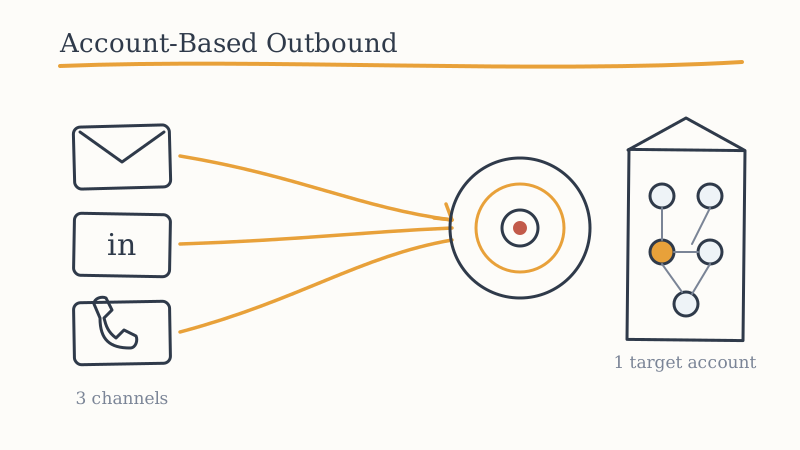
Short answer: Account-based outbound is a play where you pick a finite list of named accounts you actually want to win, map the four to eight people who decide inside each one, and run coordinated multichannel touches at all of them at once instead of spraying individual contacts and hoping. It works because B2B deals are committee decisions, not single-buyer decisions, so a sequence that reaches one person in isolation almost never moves an account. The unit of work stops being the contact and becomes the account. You measure account penetration and account-level pipeline, not reply rate on a blast. Done well, it is the highest-conversion motion in outbound because every touch is aimed at a buyer you already decided is worth winning. Done poorly, it is just spray-and-pray with a smaller list.
Most teams say they do account-based outbound and actually do not. They upload a list of “target accounts,” pull one contact per account, and drop those contacts into the same generic sequence as everyone else. That is contact-based outbound wearing an ABM label. Real account-based outbound changes three things at once: how you choose accounts, how many people you engage inside each one, and how you decide when to strike. This post walks through all three, then covers the plays, the tooling, and the metrics that tell you it is working.
What Account-Based Outbound Actually Means
The defining feature of account-based outbound is that the account is the atomic unit. In classic outbound, you build a list of thousands of contacts and run them through a cadence. Success is measured per contact: open rate, reply rate, meetings per thousand sends. In account-based outbound, you build a list of tens or low hundreds of accounts, and success is measured per account: how many of your named accounts did you get into an active conversation with, and how much pipeline did those accounts produce.
That shift has real consequences. You cannot judge an account-based play by reply rate, because you are deliberately sending fewer, more researched touches to more people inside fewer companies. A 3% reply rate across 5,000 cold contacts and a 3% reply rate across 60 deeply researched accounts are not the same motion, even though the number looks identical. The second one, run correctly, puts you in conversations with companies you specifically chose to win.
The other consequence is coordination. Because a buying decision involves multiple people, you have to reach several of them in a way that feels connected. When a VP sees your name in her inbox, then notices you commented on her director’s LinkedIn post, then hears from a peer that your company reached out too, the account starts to feel your presence. One touch to one person creates noise. A coordinated set of touches across a committee creates a pattern the account cannot ignore.
Step 1: Choose Accounts You Can Actually Win
The list is where most account-based outbound quietly fails. If your account list is just “companies that look like our customers,” you have not narrowed enough. A usable target list is scored on three things.
First, fit. These are accounts that match your ideal customer profile on the attributes that actually predict a closed deal: industry, size, business model, and the specific pains your product removes. Fit is table stakes, not a differentiator, because everyone filters on it.
Second, timing. Fit tells you an account could buy someday. Timing tells you it might buy now. Timing comes from signals: a new executive in the buying role, a funding round, a hiring surge in the team you sell to, a new office, a product launch, or a competitor relationship going stale. An account with average fit and strong timing usually beats an account with perfect fit and no reason to move this quarter.
Third, winnability. Do you have a wedge? A warm path in, a mutual connection, a displaced competitor, a public complaint you can solve. Accounts where you have an angle convert far better than cold-perfect-fit accounts where you are one of forty vendors emailing the same VP.
Score every candidate account on those three and keep the list small enough that each rep can genuinely know their accounts. A rep running true account-based plays can carry maybe 30 to 50 accounts at a time, not 500. If the list is bigger than the rep can research, you are back to spray-and-pray with extra steps.
Step 2: Map the Buying Committee, Not the Buyer
Once an account is on the list, the work is to find the people. B2B purchases in 2026 routinely involve six to ten stakeholders, and the person who signs is rarely the person who first feels the pain. A complete committee map for an account usually includes:
- The economic buyer who owns the budget.
- One or two champions who feel the problem daily and will sell internally on your behalf.
- Technical or functional evaluators who will judge whether the thing actually works.
- Blockers, often in security, legal, or finance, who can stall a deal that ignored them.
You do not pitch all of these people the same way. The champion wants to look smart to their boss, so you arm them with a business case. The economic buyer wants outcomes and risk reduction, so you lead with results and proof. The evaluator wants specifics. Multithreading a deal, reaching several of these roles in parallel instead of routing everything through one contact, is one of the strongest predictors of a closed deal, which is why we treat it as its own discipline in our guide to multithreading the B2B buying committee. The single-threaded deal dies the moment your one contact goes quiet or leaves.
Tracking who your champions are, and following them when they change jobs, turns one relationship into a repeatable pipeline source. A champion who moves to a new company is a warm account waiting to happen, which is exactly the motion tools like Champions are built to automate: watch your known advocates, alert you when they land somewhere new, and reopen the play at the new account before any competitor knows they arrived.
Step 3: Time the Play to a Real Signal
Cold outreach with no reason attached is the weakest form of outbound. Account-based outbound earns its higher conversion by striking when something has changed at the account. The best plays are triggered, not scheduled.
Useful account signals include a leadership hire in your buyer persona, a funding event, a new product or market entry, expansion into a region you serve, a competitor’s contract likely coming up for renewal, and public changes on the account’s own web properties like new pricing, a careers page hiring your buyer’s team, or a changed integrations list. That last category is easy to miss because nobody is watching competitor and target-account websites by hand. Continuous monitoring tools such as CAM watch target-account and competitor sites for exactly those changes and fire an alert the moment something moves, so your rep reaches out the week a signal appears instead of a quarter later. We go deeper on turning changes into timing in the buyer intent signals playbook.
When a signal lands, the message writes itself, because you have a genuine reason to reach out. “Saw you just opened a London office and are hiring three RevOps managers” is a first line no template can fake, and it beats “I wanted to reach out because” every time.
Step 4: Orchestrate the Multichannel Play
Now you run the play. An account-based play is a coordinated set of touches across email, LinkedIn, and phone, aimed at several committee members over two to four weeks, with the touches sequenced so they reinforce each other. A simple version looks like this.
- Week 1: Connect with the champion and one evaluator on LinkedIn with a context line, no pitch. Send a short, signal-anchored email to the champion. Engage genuinely with a post or two so your name is familiar before you ask for anything.
- Week 2: Email the economic buyer with a results-first, one-paragraph note that references the same theme the champion already saw. Follow up with the champion by phone or voice note. The account is now seeing you in three places.
- Week 3: Share a specific, useful resource with the evaluator. Ask the champion for a warm intro to the buyer now that your name is established. Add a light-touch follow-up on the buyer.
- Week 4: Break-up email that leaves the door open, plus a final LinkedIn touch. If the account went quiet, move it to a nurture track and re-trigger on the next signal.
The critical rule is coordination. The touches must share a theme and reference the same value, so that a committee comparing notes sees a coherent story rather than three unrelated reps. This is where volume-based tooling starts to fight you: a generic sequencer treats every contact as an island. Running true account-based orchestration usually means either disciplined manual play-running by a rep who owns the account, or an AI SDR layer like VSDR that can research each account, personalize per persona, and keep the multichannel touches coordinated across the committee at a volume a single human cannot sustain. For teams that would rather hand the whole motion to a partner, GroomLead builds and runs these account-based plays as a managed outbound system.
Step 5: Measure Accounts, Not Sends
If you keep grading account-based outbound on contact-level reply rate, you will kill it before it works, because the numerator is small by design. Measure the motion on account-level metrics instead.
- Account penetration: what percentage of target accounts have at least one engaged committee member. This is the leading indicator that the motion is landing.
- Committee depth: average number of engaged stakeholders per active account. Two or more is where deals start surviving a champion going quiet.
- Account-level pipeline and win rate: how much pipeline your named accounts produce, and whether they close at a higher rate than non-targeted deals. If account-based accounts do not close better, either the list or the plays need work.
- Speed to signal: how fast you act on a trigger. Reaching out the week a signal fires beats reaching out a month later, and it is one of the few metrics fully in your control, as we cover in the speed-to-lead playbook.
Reply rate still has a place as a message-quality check, but it is a diagnostic, not the scoreboard. The scoreboard is how many of the companies you set out to win are now in real conversations.
Common Ways Account-Based Outbound Goes Wrong
A few failure patterns show up again and again. The list is too big, so reps cannot research their accounts and the personalization evaporates. Only one contact per account gets touched, so the play is single-threaded and dies with that contact. The touches are uncoordinated, so the committee sees three disconnected reps instead of one coherent story. Outreach is scheduled rather than triggered, so it lands with no reason attached. And the whole thing is measured on reply rate, so leadership concludes it “does not work” and reverts to volume.
Fixing those is mostly discipline: keep the list small, engage a committee, coordinate the touches, wait for a signal, and measure at the account level. The tooling helps you scale that discipline, but it does not replace it.
The Bottom Line
Account-based outbound is not a bigger version of contact-based outbound. It is a different unit of work. You choose a finite set of accounts you can win, map the committee inside each one, wait for a real signal, and run coordinated multichannel plays at several people at once, then judge the whole thing on account penetration and pipeline rather than reply rate. The reason it converts is simple: every touch is aimed at a buyer you already decided was worth winning, at a moment when something changed, in a way the committee experiences as a pattern rather than noise.
If you want that motion running without building the signal monitoring, the committee mapping, and the multichannel orchestration in-house, that is the system GroomLead runs for its clients.
Ready to engineer your own GTM system?
GroomLead builds the outbound infrastructure behind 100+ agencies, and the tools inside this post.
Book Strategy Call